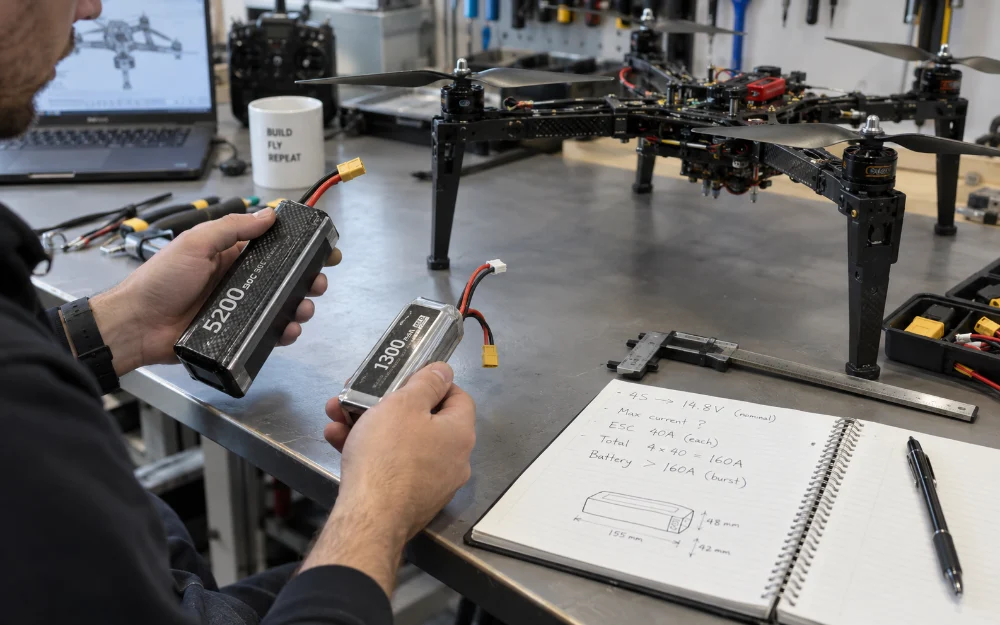
The right drone battery is not simply the pack with the highest capacity or the largest C-rating. A suitable UAV battery must first match the aircraft’s voltage, safely supply its continuous and peak current, provide enough usable energy for the mission, and remain within the platform’s weight and space limits.
That means battery selection should begin with the aircraft, not the battery catalog.
A practical sequence is:
Mission profile → Voltage → Current → Energy → Weight → Chemistry → Physical fit → Validation
Following that order helps avoid a common mistake: choosing a battery that looks powerful on paper but is poorly matched to the way the UAV actually flies.
Start with the UAV Mission Before Choosing the Battery
Before comparing cells, define what the aircraft is expected to do.
A mapping UAV flying long, steady routes has a very different battery requirement from a heavy-lift multirotor that experiences high current during takeoff and maneuvering. The battery should therefore be selected around the mission profile rather than around one headline specification.
Start by defining:
- Target flight time
- Payload
- Aircraft type
- Typical takeoff and climb demand
- Hover or cruise profile
- Operating environment
- Maximum acceptable battery weight
These factors determine how much power and energy the battery needs to provide.
Payload is particularly important. Adding payload increases the thrust required to maintain flight, which in turn increases power demand. Battery mass creates the same problem: adding more battery can increase available energy, but the aircraft must also carry that extra weight.
Research on multirotor endurance shows that battery mass, payload, required power, and flight duration are closely linked rather than independent variables. A 2025 UAV endurance study illustrates how changes in battery configuration and aircraft mass affect required power and endurance.
The first question should therefore not be:
How many mAh do I need?
It should be:
What must the battery support during the complete mission?
Match Voltage and Current Before Looking at Capacity

Voltage and current determine whether a battery can electrically support the aircraft. Capacity matters only after those requirements are satisfied.
Voltage Must Match the Propulsion System
Battery voltage must remain within the operating limits of the UAV’s motors, ESCs, avionics, and other electrical components.
In lithium battery packs, cells are connected in series to increase voltage. A higher series count produces a higher pack voltage, but that does not mean a higher-voltage battery is automatically better.
The propulsion system must be designed for it.
It is also important to distinguish between nominal voltage and fully charged voltage. The battery must remain compatible with the system across its operating voltage range, not just at the nominal rating printed on the label.
In practical terms:
Voltage is a compatibility requirement before it is a performance preference.
Changing from one pack voltage to another may change motor speed, current draw, ESC requirements, and overall propulsion behavior. It should therefore be treated as part of the aircraft architecture, not as an isolated battery upgrade.
Continuous and Peak Current Must Be Supported
Once voltage is defined, determine how much current the aircraft actually requires.
Continuous current is the electrical demand the battery must sustain during normal operation.
Peak current is the higher short-duration demand that may occur during takeoff, rapid climbing, acceleration, or other high-load events.
The selected battery should support both with reasonable operating margin.
This is more useful than selecting a battery simply because it advertises a large C-rating.
C-rating is commonly used to express discharge capability relative to battery capacity. For example, the theoretical current represented by a rating can be estimated as:
Maximum Current = Capacity in Ah × C-rating
However, that number should not be treated as the whole answer. Actual performance also depends on cell design, temperature, internal resistance, connector capability, wiring, voltage sag, and how the manufacturer defines the rating.
UAV flight controllers themselves account for battery current and voltage limitations. ArduPilot, for example, supports battery current limiting and voltage scaling, reflecting the fact that excessive current demand and voltage drop can directly affect aircraft performance.
A battery with plenty of capacity but insufficient current capability is still the wrong battery.
Choose Capacity by Energy, Flight Time and Weight Together
Battery capacity is important, but mAh alone does not tell you how much useful flight energy a pack provides.
For packs operating at different voltages, watt-hours are usually a more useful comparison:
Wh = Nominal Voltage × Capacity in Ah
For example, two batteries may both be rated at 5,000 mAh but store different amounts of energy if their nominal voltages differ.
That does not mean the pack with the most watt-hours is always the better UAV battery.
More energy normally requires more battery mass. Extra mass increases the power the aircraft needs to produce lift, which can reduce the benefit gained from the additional battery capacity.
This creates one of the central trade-offs in UAV battery selection:
Adding battery energy can extend the mission, but adding battery mass also makes the mission more energy-intensive.
That is why moving from a 5,000 mAh pack to a 10,000 mAh pack does not automatically double flight time.
The result depends on:
- Additional battery mass
- Aircraft efficiency
- Payload
- Propulsion system
- Flight speed
- Hover versus cruise time
- Wind and operating conditions
- Usable battery reserve
Mission planning should also avoid assuming that every amp-hour printed on the pack can be consumed in flight. UAV platforms commonly use low-voltage or remaining-capacity failsafes so that the aircraft can land before the battery is completely depleted. ArduPilot, for example, allows battery failsafe actions based on voltage or remaining capacity.
For battery selection, the goal is therefore not maximum capacity.
It is enough usable energy for the mission without carrying unnecessary battery mass.
Select Chemistry and Form Factor After the Electrical Requirements Are Known
Chemistry should come after voltage, current, and energy requirements are defined.
For most UAV projects, LiPo and Li-ion are common starting points, but they suit different priorities.
LiPo batteries are often evaluated when the UAV needs strong peak-current capability, dynamic power delivery, or a pouch format that fits the available airframe geometry.
Li-ion batteries are often evaluated when usable energy and endurance are more important, provided the selected cells can safely meet the aircraft’s current requirements.
The important point is that neither category should be selected by habit.
A long-endurance UAV may benefit from an energy-oriented Li-ion pack, while a platform with heavy peak loads may require a high-rate solution. Modern high-power cylindrical cells also mean the traditional line between “high-power LiPo” and “low-power Li-ion” is less clear than it once was.
The correct decision should therefore be made at the specific cell and pack level.
Lithogenix also offers lithium-ion cylindrical cell platforms that can be evaluated for power-focused, balanced, and endurance-oriented UAV designs.
Check Weight, Dimensions and Physical Integration
A battery can be electrically compatible and still be a poor fit for the aircraft.
Before final selection, verify how the finished pack integrates with the UAV.
Important checks include:
- Finished pack dimensions
- Total battery weight
- Battery bay dimensions
- Mounting position
- Center of gravity
- Connector type
- Cable gauge and length
- Cable exit direction
- Charging compatibility
- Operating temperature
- Protection or monitoring requirements
Weight deserves particular attention.
A battery may provide excellent electrical performance, but if it pushes the aircraft beyond its practical weight budget, reduces payload capacity, or moves the center of gravity too far from the intended position, it may create more problems than it solves.
The same applies to connectors and wiring. They must be capable of safely carrying the required current and fitting the actual installation layout.
Professional UAV battery suppliers therefore typically request more than voltage and capacity. Custom-development inputs often include current requirements, battery dimensions, weight limits, connector specifications, and operating conditions. Custom UAV battery design processes commonly begin with these aircraft-level constraints.
This leads to an important distinction:
Compatible does not always mean suitable.
A battery may plug in and power the UAV, yet still be too heavy, thermally stressed, current-limited, or mechanically awkward for the mission.
A Practical Drone Battery Selection Checklist
The following sequence provides a useful starting point for most drone and UAV projects.
| Selection Factor | What to Determine | Why It Matters |
|---|---|---|
| Mission | Flight time, payload, flight profile | Defines the overall power and energy requirement |
| Voltage | Required pack voltage | Ensures compatibility with motors, ESCs, and electronics |
| Continuous Current | Normal operating current | Prevents sustained battery overload |
| Peak Current | Takeoff, climb, and acceleration demand | Ensures short-duration high-load capability |
| Energy | Required Wh | Supports the intended mission duration |
| Weight | Maximum acceptable battery mass | Affects payload and flight efficiency |
| Size | Available battery space | Determines mechanical compatibility |
| Chemistry | Suitable LiPo or Li-ion platform | Matches power and energy priorities |
| Connector | Type and current capability | Supports reliable electrical integration |
1. Define the Mission
Specify target flight duration, payload, operating profile, and environment.
2. Confirm Pack Voltage
Match the battery voltage range to the propulsion system and onboard electronics.
3. Determine Continuous Current
Estimate the normal current demand during hover, cruise, or typical operation.
4. Determine Peak Current
Account for takeoff, climbing, acceleration, and other demanding flight phases.
5. Set the Energy Target
Estimate the usable watt-hours required for the mission rather than relying on mAh alone.
6. Check Weight and Available Space
Confirm that the battery can fit without creating an excessive mass penalty or integration problem.
7. Select the Cell Platform and Validate the Pack
Only after those constraints are known should you compare chemistry, cell type, series-parallel configuration, and final battery architecture.
If you cannot yet define the required voltage, peak current, target flight time, battery bay size, and maximum battery weight, the final battery selection is probably premature.
Final Takeaway
Choosing the right battery for a drone or UAV is primarily a constraint-matching process.
Start by matching the battery to the aircraft’s voltage and current requirements. Then determine how much usable energy the mission needs without exceeding the platform’s weight and space limits. Chemistry, capacity, and cell format should follow those requirements rather than lead the decision.
A standard battery may be sufficient when those constraints are straightforward. When voltage, current, endurance, weight, dimensions, or interfaces cannot be satisfied by an off-the-shelf pack, the next step is to evaluate a battery architecture around the aircraft itself.
Frequently Asked Questions
Is a Higher C-Rating Always Better for a Drone Battery?
No. The battery needs enough discharge capability to meet the UAV’s continuous and peak current with suitable margin, but a larger advertised C-rating does not automatically improve flight performance. Actual cell capability, voltage sag, temperature, wiring, and connector limits still matter.
Should I Compare Drone Battery Capacity in mAh or Wh?
mAh is useful when comparing batteries with the same voltage. When pack voltages differ, Wh gives a better indication of total stored energy because it accounts for both voltage and capacity.
When Should I Consider a Custom UAV Battery Instead of a Standard Pack?
A custom battery becomes worth evaluating when standard packs cannot meet the required combination of voltage, peak current, endurance, weight, dimensions, connector layout, or monitoring requirements. In that situation, the battery architecture can be defined around the UAV’s actual operating profile rather than forcing the aircraft to accept a standard pack.