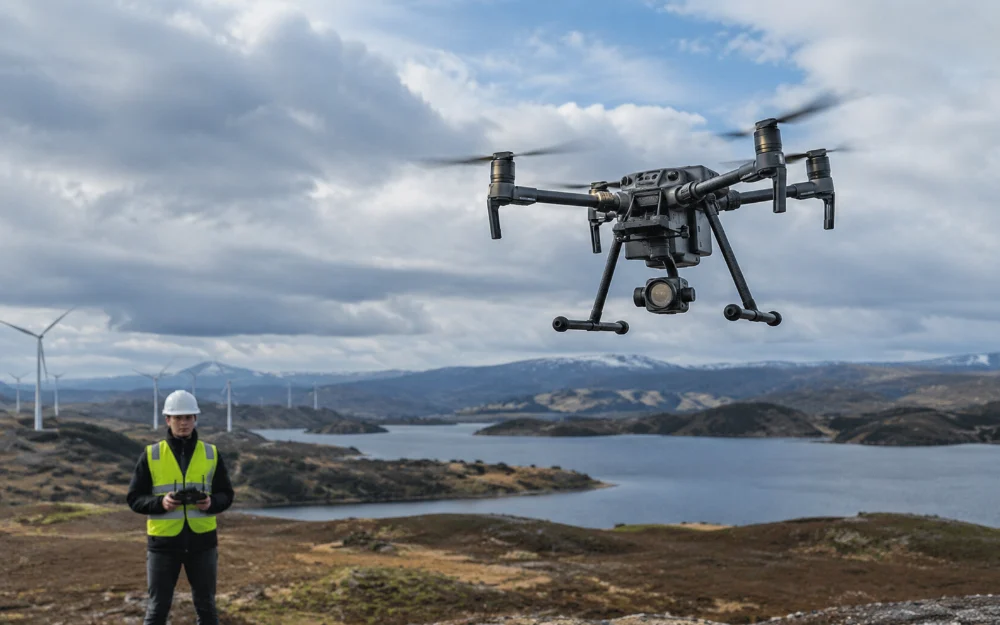
Drone flight time is determined by the balance between usable battery energy and how quickly the aircraft consumes that energy. Battery capacity matters, but it is only one part of the equation. Battery weight, payload, propulsion efficiency, flight profile, wind, temperature, and the amount of energy reserved for a safe landing all influence how long a UAV can actually remain airborne.
That is why a larger battery does not automatically produce a proportional increase in flight time. More battery capacity usually means more stored energy, but it also means more mass for the aircraft to carry.
In this article, “drone battery life” refers to flight time per charge, not how many cycles or years the battery will last.
Flight Time Comes Down to Usable Energy and Power Demand
A useful way to understand drone endurance is:
Estimated Flight Time ≈ Usable Battery Energy ÷ Average Power Consumption
This is not a precise flight-time formula because UAV power demand changes continuously during a mission. It does, however, explain why almost every factor that affects flight time belongs to one of two groups.
Usable Battery Energy
The battery determines how much energy is available to the aircraft. Important variables include:
- Battery voltage
- Capacity
- Total watt-hours
- Low-voltage limits
- Required landing reserve
- Battery condition
For batteries with different voltages, watt-hours are generally more useful than mAh when comparing stored energy:
Wh = Nominal Voltage × Capacity in Ah
However, the full rated capacity should not normally be treated as available mission energy. UAV flight-control systems commonly use low-voltage or remaining-capacity failsafes so the aircraft can return or land before the battery is fully depleted. ArduPilot, for example, allows battery failsafe actions based on voltage and remaining capacity.
Average Power Consumption
The aircraft determines how quickly that stored energy is consumed.
Average power demand changes with:
- Aircraft mass
- Payload
- Propulsion efficiency
- Hover and cruise time
- Acceleration and climbing
- Flight speed
- Wind
- Operating temperature
The same battery can therefore produce very different flight times on two aircraft—or even on the same aircraft performing two different missions.
| Factor | Main Effect | Typical Effect on Flight Time |
|---|---|---|
| More usable battery energy | More energy available to the UAV | Increases |
| Higher battery mass | More thrust and propulsion power required | Decreases |
| Higher payload | Raises aircraft power demand | Decreases |
| More efficient propulsion | Uses less energy for the same task | Increases |
| Aggressive flight | Raises average current and power demand | Decreases |
| Strong wind | Requires additional stabilization or propulsion | Usually decreases |
| Low temperature | Can reduce usable battery performance | Usually decreases |
| Larger safety reserve | Leaves less energy available for the planned mission | Reduces planned mission time |
Does a Bigger Battery Always Mean Longer Flight Time?
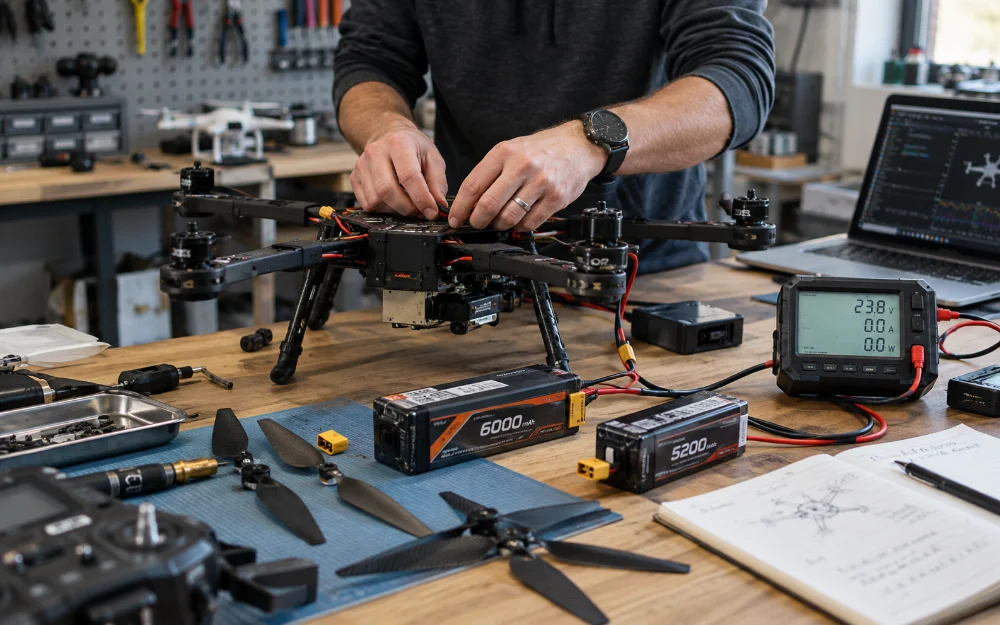
No. A larger battery can increase flight time, but the gain is rarely proportional to the increase in capacity.
Consider replacing a 5,000 mAh battery with a 10,000 mAh battery. The new pack may contain roughly twice as much charge at the same voltage, but it will also be heavier.
The UAV now has to produce additional thrust throughout the entire flight to carry that extra battery mass.
The result is a trade-off:
Stored Energy ↑ → Battery Mass ↑ → Required Power ↑
Some of the additional battery energy is therefore spent simply carrying the larger battery.
Research into multirotor endurance confirms that battery mass, aircraft mass, required power, and flight time are tightly coupled. A 2025 study of multirotor UAV battery configurations found that adding battery mass can increase available energy while simultaneously increasing the propulsion power required to remain airborne. The study highlights the importance of balancing battery capacity against the energy cost of carrying additional mass.
Practical multicopter testing has shown the same diminishing-return effect. Increasing battery capacity can initially extend flight time, but beyond a certain point, each additional gram of battery produces less useful endurance improvement. Real-world battery-size testing demonstrates why the largest pack an aircraft can physically lift is not necessarily the most efficient choice.
The better question is therefore not:
What is the largest battery my drone can carry?
It is:
What battery provides enough usable energy without creating an excessive weight penalty?
Aircraft Weight and Payload Directly Affect Endurance
Battery weight is only one part of the total aircraft mass. The UAV may also carry cameras, LiDAR units, inspection sensors, spraying equipment, communication systems, or cargo.
Both battery mass and payload increase the thrust required to keep the aircraft airborne, but there is an important difference:
Battery mass brings additional stored energy with it. Payload does not.
Adding a larger camera, sensor package, or cargo load therefore increases power consumption without directly increasing the amount of energy available to the aircraft.
As aircraft mass increases, the propulsion system generally has to work harder to maintain altitude and perform the same maneuvers. That higher motor demand increases current draw and shortens the time required to consume the battery’s usable energy.
Experimental UAV research has repeatedly shown this effect. Flight tests reported in Nature Communications found that payload, flight speed, and environmental conditions all influenced quadrotor energy use and flight duration. The results demonstrate why endurance must be evaluated under realistic payload and mission conditions rather than from battery specifications alone.
This also explains why comparing two drones only by battery capacity can be misleading. A heavier aircraft may carry a larger battery yet still have shorter endurance if its average power requirement is much higher.
Flight Profile and Propulsion Efficiency Change How Fast Energy Is Used
Flight time is not a fixed property of the battery. It is the result of how the aircraft uses that battery during a specific mission.
Takeoff, climbing, hovering, forward flight, rapid acceleration, and repeated turns can all require different levels of power.
A multirotor that spends much of its mission hovering may consume energy differently from one that spends most of its time moving efficiently forward. A fixed-wing UAV has a different energy profile again because aerodynamic lift supports the aircraft during cruise.
Mission structure also matters.
A route involving repeated:
- Takeoffs and climbs
- Stops and hovering
- Tight turns
- Acceleration and deceleration
- High-speed segments
may consume considerably more energy than a smooth, steady mission covering a similar distance.
Recent UAV energy-efficiency research has highlighted the effect of acceleration, turning, environmental conditions, and operating profile on mission-level power demand. The findings reinforce that real UAV endurance cannot be predicted reliably from nominal battery capacity alone.
Propulsion efficiency also influences the result. Motors, propellers, ESCs, aircraft aerodynamics, and operating point determine how efficiently electrical energy becomes useful thrust.
Two UAVs carrying batteries with the same stored energy may therefore achieve very different flight times.
Flight time is a mission result, not simply a battery specification.
Wind, Temperature and Real Operating Conditions Matter
Published maximum flight-time figures are normally measured under specific conditions. Real missions rarely reproduce those conditions perfectly.
Wind
Wind can change the power required to maintain position, stabilize the aircraft, or follow a planned route.
A multirotor hovering in gusty conditions may require repeated thrust corrections. Flying against the wind can also increase propulsion demand compared with calm conditions.
Experimental work on quadrotor battery consumption has found that wind conditions can measurably change energy use during flight. Wind therefore needs to be considered when estimating real mission endurance.
Temperature
Temperature affects both the aircraft and the battery.
Low temperatures can reduce the usable performance of lithium batteries and increase voltage drop under load. A battery that performs normally under moderate conditions may therefore provide less usable energy or power margin during cold-weather operation.
Temperature, turbulence, and other environmental factors can also change aircraft energy demand. For professional UAV operations, realistic endurance estimates should therefore include appropriate environmental margin rather than relying only on ideal bench or specification-sheet values.
Estimate Realistic Mission Time, Not Theoretical Maximum Flight Time
For a professional UAV project, the most useful number is usually not the longest flight the aircraft could theoretically achieve.
It is the time the UAV can reliably perform its intended mission while retaining enough energy to return and land safely.
A practical endurance estimate should therefore consider:
1. Usable Battery Energy
Compare available watt-hours rather than relying only on mAh, especially when pack voltages differ.
2. Typical Mission Power
Use realistic hover, cruise, climbing, and maneuvering demand rather than assuming one constant ideal power level.
3. Actual Payload
Calculate endurance with the camera, sensor, cargo, or other equipment the UAV will actually carry.
4. Finished Battery Mass
When comparing different capacities, include the weight increase created by the larger pack.
5. Environmental Margin
Allow for wind, temperature, route variation, and other operating conditions that may raise power consumption.
6. Landing Reserve
Do not plan to use 100% of nominal battery capacity during a normal mission. Maintain sufficient reserve for return-to-home, landing, and unexpected conditions.
This approach produces a more useful engineering target than simply pursuing the highest possible laboratory or marketing flight-time figure.
A UAV battery should be sized for the mission the aircraft actually performs, not for an ideal maximum-flight-time test.
Final Takeaway
Drone battery life per charge depends on two things: how much usable energy the battery provides and how quickly the UAV consumes it.
A larger battery can increase endurance, but additional battery mass, payload, inefficient propulsion, aggressive flight, wind, temperature, and safety reserve can all reduce the expected gain.
For professional UAV design, the better target is therefore realistic mission endurance rather than maximum mAh or theoretical flight time. Once the required flight duration, payload, power demand, and operating conditions are defined, the battery pack can be sized around those constraints.
Frequently Asked Questions
Why Is My Drone Flight Time Shorter Than the Manufacturer’s Rating?
Maximum flight-time ratings are usually measured under defined payload, speed, weather, and battery conditions. Real missions may include additional payload, wind, hovering, climbing, repeated maneuvers, and a required landing reserve, all of which can reduce actual flight time.
Should Drone Battery Life Be Compared in mAh or Wh?
mAh is useful when comparing batteries with the same voltage. When battery voltages differ, Wh is more useful because it represents stored energy using both voltage and capacity.
Does Battery Age Reduce Drone Flight Time?
Yes. As a lithium battery ages, usable capacity can decline and internal resistance may increase, which can lead to greater voltage drop under load and shorter usable flight time. Long-term battery aging, cycle life, and storage are separate from single-charge endurance and should be evaluated independently.