
Custom Drone Battery Solutions for UAV Platforms
- UAV BATTERY DESIGN REQUIREMENTS
What Drone Platforms Require from Their Batteries
A drone battery has to match more than voltage and capacity. Flight duration, peak current, payload, available space, operating temperature, and expected service life all influence the right pack architecture. Lithogenix evaluates these requirements together before defining the battery platform.
A suitable backup battery therefore needs to do more than provide sufficient capacity. It must remain ready during standby, respond when the main power source is interrupted, and recover appropriately once normal power is restored.
Flight Time & Mission Duration
Required runtime influences cell capacity, pack configuration, and total battery weight. The right design balances usable energy with the aircraft’s flight profile rather than maximizing capacity alone.
Payload & Power Demand
Payload, propulsion demand, acceleration, climbing, and other high-load operating phases can significantly increase battery current requirements. Continuous and peak discharge capability should be matched to the actual mission.
Voltage & Current Requirements
Battery voltage must align with the propulsion system, ESCs, onboard electronics, and power distribution design. The final configuration is selected according to the complete electrical system, not as an isolated component.
Weight, Space & Operating Environment
Available installation space, total battery weight, operating temperature, and service-life expectations all influence cell format and pack construction. These constraints need to be considered together during battery development.
- DRONE BATTERY POWER PLATFORMS
Standard LGX Battery Packs for UAV Platforms
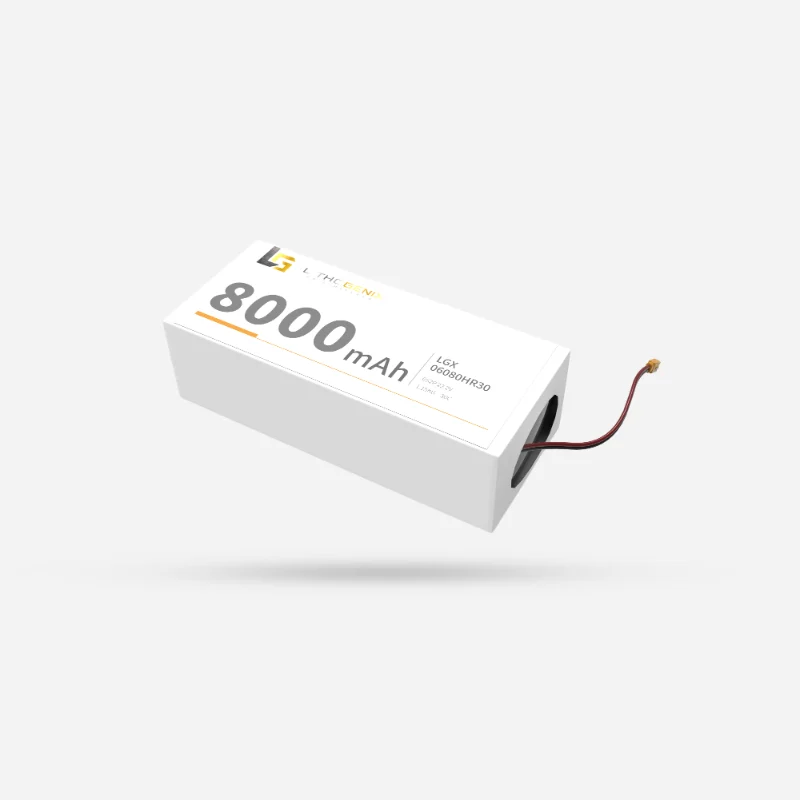
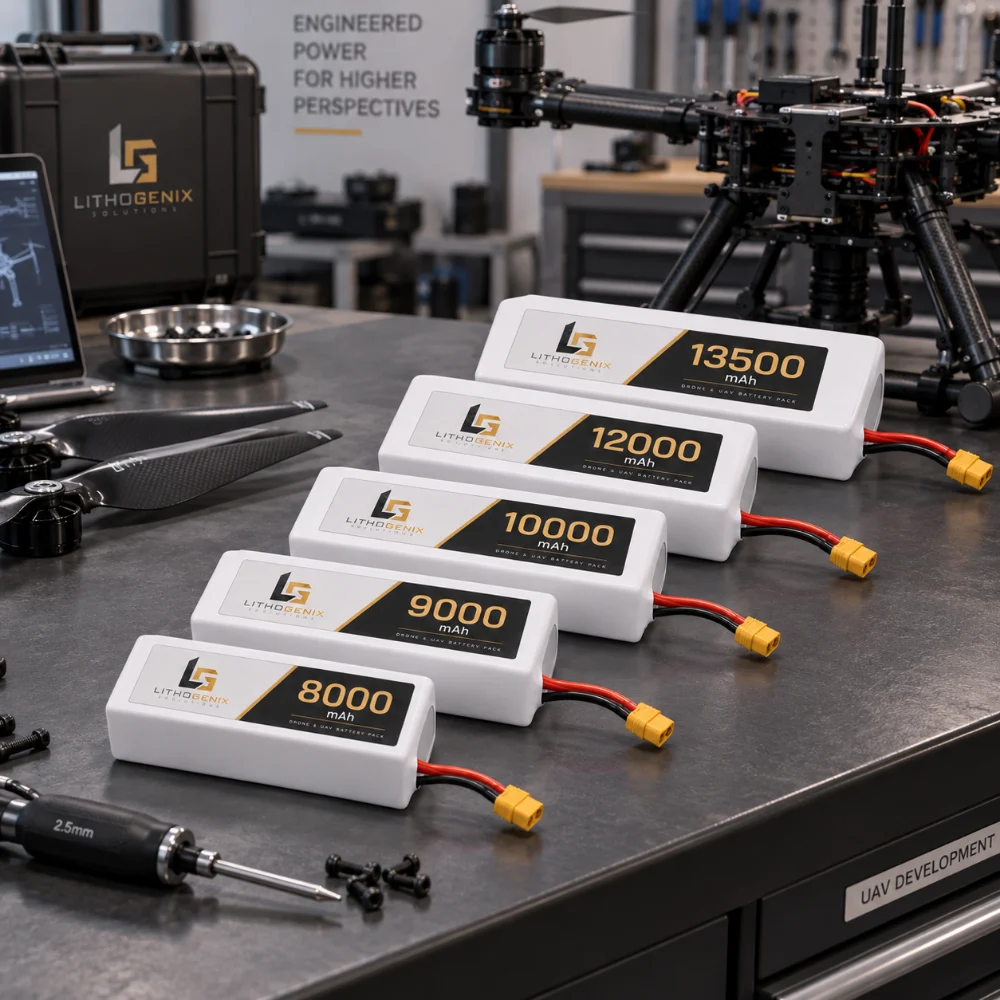
Not every UAV project requires a fully bespoke battery. Lithogenix offers a range of standard LGX lithium-ion battery packs covering different energy capacities, system voltages, and discharge requirements. These established configurations provide a practical starting point for projects that need faster integration, while custom development remains available when the aircraft requires a different electrical or mechanical architecture.Different cell platforms can be selected according to the UAV’s discharge demand and flight profile, then configured into a battery pack around the required voltage, capacity, and mechanical layout.
Cell selection can be matched to the required discharge rate, operating cycle, and backup duty of the target system before being configured into a finished battery pack or module.
Standard LGX Battery Packs
Explore Our Lithium-ion Battery Packs
Proven configurations for faster project integration.
When an existing LGX model already matches the required voltage, capacity, discharge performance, and available installation space, a standard battery platform can provide a more direct route to integration.
Using an established configuration can help reduce unnecessary development work while giving the project a defined starting point for electrical and mechanical integration.
Key Characteristics
- Required voltage matches an existing battery platform
- Capacity falls within the available LGX range
- Continuous discharge requirements are already covered
- Pack dimensions fit the available battery compartment
- Standard electrical interfaces can be adapted to the aircraft
| Model | Capacity | Nominal Voltage | Continuous Discharge | Max. Discharge |
|---|---|---|---|---|
| LGX06080 | 8000mAh | 22.2V | 10C | 15C |
| LGX06080HR30 | 8000mAh | 22.2V | 30C | — |
| LGX06090 | 9000mAh | 22.2V | 10C | 15C |
| LGX06100 | 10000mAh | 22.2V | 10C | 15C |
| LGX06100HR35 | 10000mAh | 22.2V | 35C | — |
| LGX06120 | 12000mAh | 22.2V | 10C | 15C |
| LGX06120HR45 | 12000mAh | 29.6V | 45C | — |
| LGX06135 | 13500mAh | 22.2V | 10C | 15C |
- CUSTOM UAV BATTERY PACK ENGINEERING
Engineered Around Your UAV Architecture
A custom UAV battery pack has to work as part of the aircraft, not as a standalone component. Lithogenix develops the electrical configuration, BMS, mechanical structure, and system interfaces together so the finished pack can match the UAV’s power demand, installation space, communication requirements, and operating environment.
The goal is to define a battery configuration that can be integrated into the customer’s UPS, control equipment, or critical power system without forcing the surrounding equipment to adapt around a fixed pack design.
Electrical Configuration
Voltage, capacity, discharge rate, and series configuration matched to the UAV’s propulsion and mission requirements.
BMS & Power Management
Lightweight BMS integration with protection, SOC monitoring, thermal management, and communication options such as CAN Bus.
Mechanical Integration
Pack dimensions, brackets, enclosures, and lightweight structures designed around the UAV’s available space and mounting requirements.
Connector & System Interface
Custom cables, connectors, charging interfaces, and signal connections configured to match the aircraft’s electrical system.
- UAV Battery Testing & Validation
Tested Before It Flies
A UAV battery pack has to perform reliably under real electrical loads and real operating conditions. Lithogenix combines bench testing, end-of-line verification, accelerated reliability testing, and actual drone flight validation to evaluate battery performance before production release.
25kW High-Current Testing
Validate pack behavior under demanding electrical loads.
High-current testing helps verify that the battery pack can support the power demands defined for the application before it moves into production.
HALT Testing
Expose potential weaknesses earlier in development.
HALT procedures are used as part of the validation process to identify design weaknesses and improve reliability before the battery reaches full production.
Multi-Channel EOL Testing
Verify finished packs at the end of production.
Multi-channel end-of-line testing provides a final verification step for completed battery packs before they leave the manufacturing process.
Real-World Flight Validation
Confirm battery performance with actual UAV flight data.
Lithogenix supports real-world drone flight testing and works with drone manufacturers’ laboratories to evaluate reliability using data collected under actual flight conditions.
- UAV APPLICATIONS
Battery Solutions for Different Drone Missions
Different UAV applications place very different demands on the battery system. Flight duration, payload, discharge current, operating environment, and available installation space all influence how the pack should be configured. Lithogenix develops battery solutions around the operating profile of each platform rather than applying one standard pack to every drone.

Industrial Inspection UAVs
Inspection drones used around power lines, factories, pipelines, and infrastructure need dependable output throughout repeated missions. Battery design should support stable power delivery, predictable flight time, and reliable operation across changing field conditions.
Mapping & Survey Drones
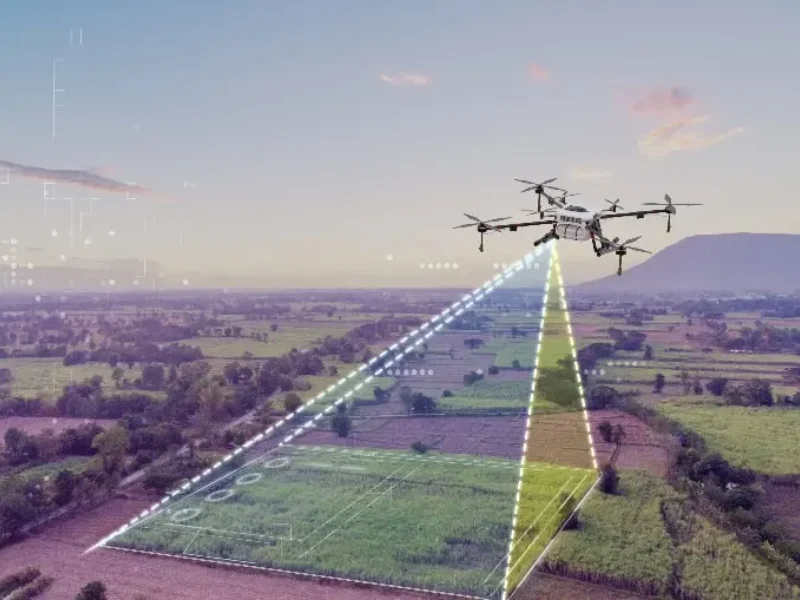
Mapping and survey platforms often prioritize endurance and weight efficiency. The battery system must provide enough usable energy for longer flight paths while keeping total pack mass under control so payload capacity and flight efficiency are not compromised.

Agricultural Drones
Agricultural UAVs frequently operate with heavier payloads and higher motor demand during takeoff, spraying, and maneuvering. Battery packs therefore need strong current capability, stable voltage under load, and a structure suited to repeated field operation.
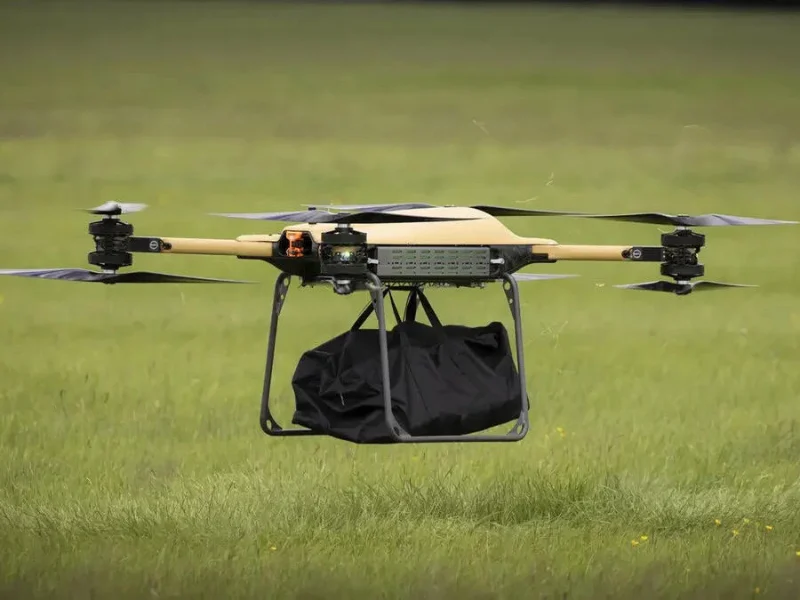
Logistics & Heavy-Lift UAVs
Delivery and heavy-lift platforms place significant demands on both energy and power. Battery configuration must account for payload variation, peak current during lift and acceleration, pack weight, and the available installation space within the aircraft.
- FAQs
FREQUENTLY ASKED QUESTIONS
We typically review the UAV type, target flight time, payload, required pack voltage, continuous and peak current, available battery space, maximum battery weight, connector requirements, and expected order volume.
Cell selection depends on the balance between power demand, usable energy, weight, size, and flight duration. High-current missions may require a power-focused cell, while long-endurance UAVs usually place greater emphasis on energy capacity and pack weight.
Yes. The series and parallel configuration can be designed around the required system voltage, capacity, discharge current, and available installation space.
Yes. Pack dimensions, wiring, cable length, connector type, polarity, and mechanical layout can be adapted to the UAV platform and battery bay requirements.
Not always. A higher-capacity pack also adds weight, which can increase motor load and energy consumption. Flight time depends on the overall balance between battery energy, pack weight, payload, propulsion efficiency, and flight profile.
A BMS or protection circuit can be integrated according to the battery architecture and application requirements, including functions such as voltage, current, temperature, overcharge, over-discharge, and short-circuit protection.
Yes. Prototype evaluation is an important part of custom UAV battery development. The sample can be tested for electrical performance, fit, temperature behavior, voltage stability, and actual aircraft operation before the production specification is finalized.
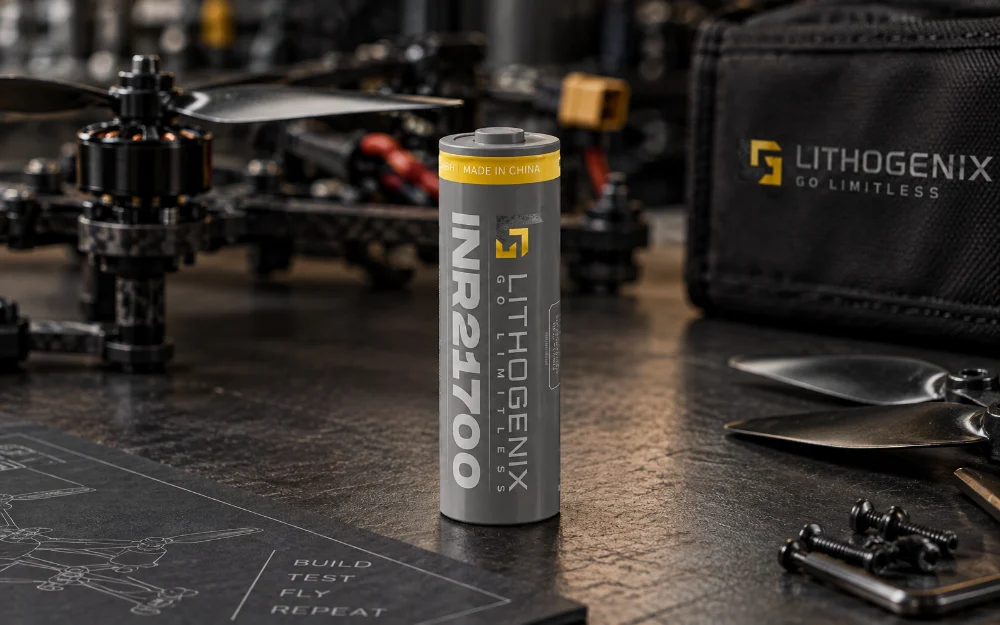
Lithogenix currently offers high-power and high-energy lithium-ion cylindrical cells, including INR18650 and INR21700 platforms. The appropriate cell depends on the UAV’s current demand, flight duration, weight target, and pack configuration.