
LiFePO₄ Golf Cart Battery Manufacturer
36V & 48V Golf Cart Battery Platforms
Choose between two LiFePO₄ battery platforms developed for common golf cart voltage systems. Both models combine high-current output, integrated protection, and durable construction for daily vehicle operation.
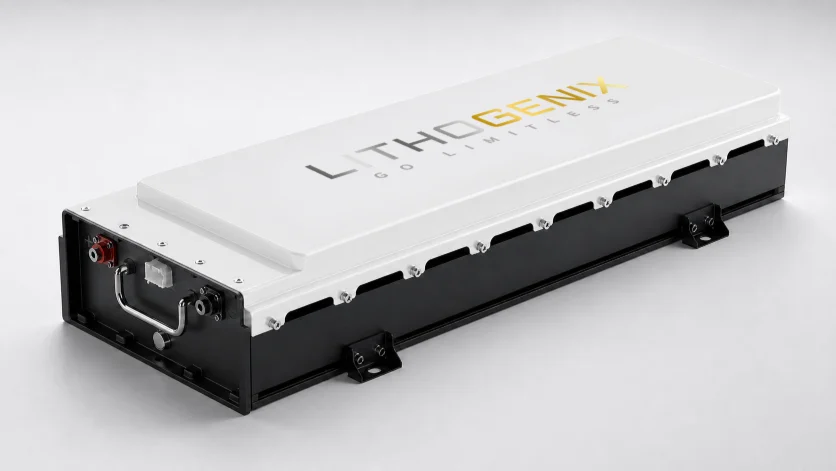
LAR36105-G4D-P
38.4V · 104Ah · 3993.6Wh
A compact LiFePO₄ battery platform for compatible 36V-class golf carts, utility carts, sightseeing vehicles, and other low-speed electric vehicles.
For 36V-Class Vehicle Systems
Designed for vehicles using a compatible 36V-class electrical architecture. Final fit should be confirmed against controller current, charger specification, communication requirements, and available installation space.
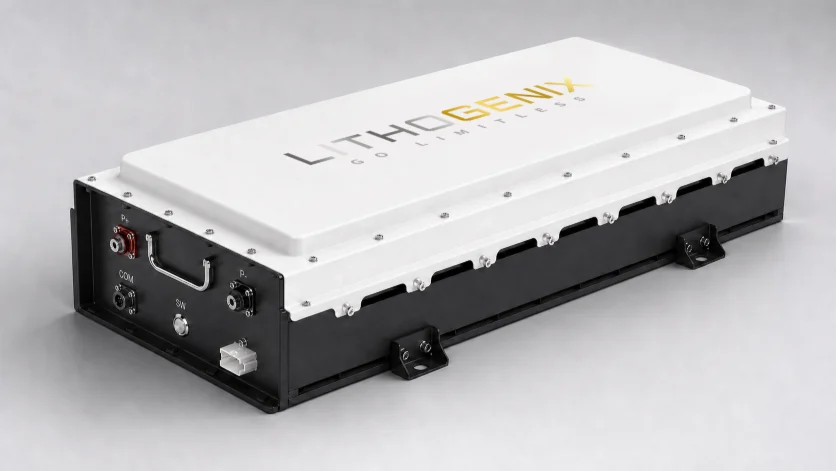
LAR48105-G8D-P
51.2V · 104Ah · 5324.8Wh
A higher-energy LiFePO₄ battery platform for compatible 48V-class golf carts and low-speed electric vehicles requiring strong current delivery and greater onboard energy.
For 48V-Class Vehicle Systems
Designed for compatible 48V-class electrical systems. Vehicle voltage alone is not enough to confirm replacement suitability; controller current, charger settings, communication protocol, and installation dimensions should also be checked.
Not sure which platform fits your vehicle? Share your vehicle voltage, controller current, charger specification, communication requirements, and installation dimensions with our team for a compatibility review.
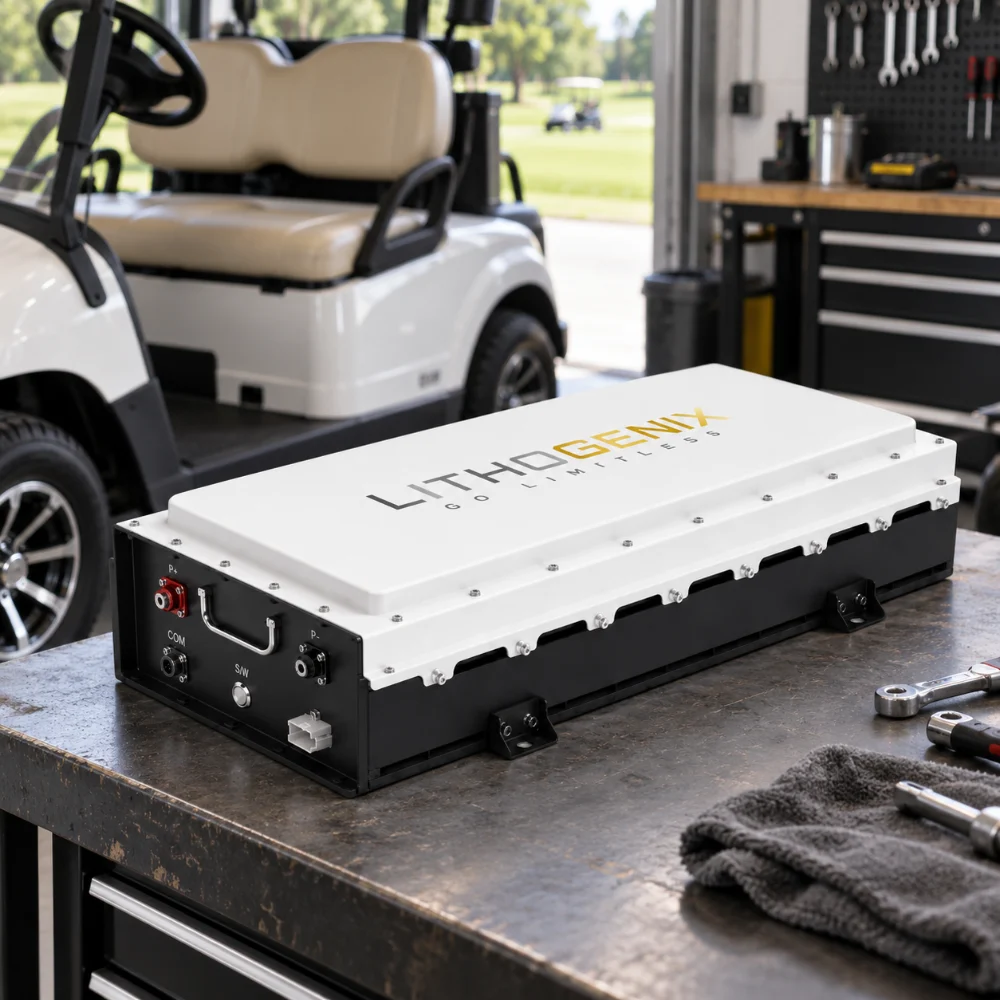
- Lead-Acid Replacement Compatibility
Check Compatibility Before Replacing Lead-Acid Batteries
A lithium upgrade should match the vehicle as a complete electrical system, not just the nominal voltage. We review the key operating and installation requirements before confirming whether a Lithogenix LiFePO₄ battery platform is suitable for your golf cart.
Match the Battery to the Vehicle Voltage
Confirm the golf cart’s existing electrical system before selecting a replacement battery. Our current platforms are designed around 36V-class and 48V-class vehicle architectures, but nominal voltage alone does not determine compatibility.
Check the Vehicle’s Current Demand
The battery must support the current required by the motor controller during normal driving, acceleration, hill climbing, and higher-load operation. Controller requirements are reviewed against the battery pack’s available discharge capability before fit is confirmed.
Verify Charging Compatibility
The existing charger should be checked against the lithium battery’s required charging voltage and current profile. A charger designed for a lead-acid system should not automatically be assumed to be suitable for a LiFePO₄ replacement.
Make Sure the Battery Fits the Available Space
Battery length, width, height, terminal position, cable routing, and mounting space should be checked against the vehicle’s battery compartment before installation. Physical fit is just as important as electrical compatibility.
- Daily Driving Performance
Power That Holds Up Through Daily Operation
Lithogenix LiFePO₄ golf cart batteries are designed for repeated daily use, combining long cycle life with the current capability needed for acceleration, hill climbing, and load-carrying operation.
Long-Term Operating Value
More than 3,000 cycles at 80% DOD help extend battery service life and reduce replacement frequency across regular fleet operation.
Sustained Power for Daily Driving
Up to 200A continuous discharge supports steady power delivery during normal driving, prolonged climbs, and higher-load vehicle operation.
Power When Demand Rises
Up to 400A peak discharge for 35 seconds provides additional current capability for acceleration, hill starts, and short periods of heavy load.
Stable Performance Across Repeated Use
LiFePO₄ chemistry combines strong thermal stability with durable cycle performance, making it well suited to golf carts and other low-speed electric vehicles used on a regular basis.
- Intelligent Battery Management
Protection and Visibility Built Into the Battery
An integrated battery management system helps protect the pack during everyday operation while Bluetooth and RS485 communication provide easier access to key battery information for diagnostics, maintenance, and vehicle integration.
A suitable backup battery therefore needs to do more than provide sufficient capacity. It must remain ready during standby, respond when the main power source is interrupted, and recover appropriately once normal power is restored.
Protection Against Electrical Stress
The integrated BMS helps protect the battery against overvoltage and overcurrent conditions, supporting safer charging and discharge behavior during normal golf cart operation.
Built-In Response to Abnormal Conditions
Overtemperature and short-circuit protection add another layer of system protection, helping reduce risk when the battery operates outside its intended electrical or thermal range.
Easier Access to Battery Operating Data
Bluetooth connectivity allows key battery information to be accessed more conveniently during inspection and maintenance, helping operators identify operating conditions without relying only on external measurements.
Ready for System-Level Integration
RS485 communication supports data exchange with compatible vehicle, charging, display, or fleet-management systems where required by the application architecture.
Charging & Operating Window
Designed for Efficient Charging and Everyday Conditions
Our golf cart LiFePO₄ battery platforms support flexible charging and a broad operating temperature range, helping reduce charging downtime while maintaining reliable vehicle operation across changing outdoor conditions.
The standard charging current for both current Golf Cart Battery platforms.
Higher supported charging current provides additional flexibility where the charging system is appropriately matched.
Operating Temperature Range
Current 36V & 48V platforms
Charger compatibility should be confirmed before installation. Maximum charging voltage, charging profile, current capability, and the vehicle's existing charging system should be reviewed before replacing a lead-acid battery.
- OEM Battery Integration
Adapted Around Your Vehicle Platform
Not every golf cart project fits a standard battery configuration. Lithogenix can evaluate electrical, mechanical, connection, and system-integration requirements around your vehicle platform, helping determine whether an existing battery model can be adapted or whether a more application-specific solution is needed.
Match the Pack to the Vehicle Load
Vehicle voltage, capacity target, controller demand, peak current, and expected operating profile are reviewed together before the battery configuration is defined. For projects that cannot use an existing platform directly, the electrical requirements can be evaluated against Lithogenix’s broader custom battery-pack capabilities.
Fit the Battery Into the Existing Electrical Layout
Cable length, terminal arrangement, and connector requirements can affect how easily a battery integrates into an existing vehicle platform. Lithogenix’s standard and custom battery-pack capability includes support for custom cable lengths, connector options, and mechanical adaptations on request. d00509a2e328d744abd791a35ef8c35…
Designed Around the Available Installation Space
Battery compartment dimensions, mounting points, terminal access, and cable routing should all be considered before finalizing the pack. Where required, the project can be reviewed for mechanical adaptation so the battery system fits the available vehicle space without treating installation as an afterthought.
Connect Battery Management With the Vehicle System
Communication requirements should be identified early when the battery needs to interact with a charger, display, controller, or fleet-management system. Current Golf Cart Battery platforms support Bluetooth and RS485 communication, while any additional integration requirement should be confirmed during project evaluation. d26e7c12a7c96661cf88def5672a613…
- FAQs
FREQUENTLY ASKED QUESTIONS
Yes, they can be considered for compatible lead-acid replacement projects, but compatibility should be confirmed before installation.
Vehicle voltage alone is not enough. The controller current, charger specification, communication protocol, battery compartment dimensions, and installation requirements should also be reviewed before selecting the replacement pack.
The correct platform depends on the electrical architecture of your vehicle.
Lithogenix currently offers:
- LAR36105-G4D-P: 38.4V / 104Ah / 3993.6Wh
- LAR48105-G8D-P: 51.2V / 104Ah / 5324.8Wh
Before selection, the vehicle system voltage and controller requirements should be confirmed rather than choosing based only on the nominal “36V” or “48V” label.
The existing charger should be checked against the lithium battery’s required charging voltage, charging profile, and current limits before reuse. The current 38.4V and 51.2V platforms have maximum charging voltages of 43.8V and 58.4V respectively.
If the existing charger does not match the battery requirements, a compatible charging solution will be required.
Both current Lithogenix Golf Cart Battery models are specified for more than 3,000 cycles at 80% depth of discharge. d26e7c12a7c96661cf88def5672a613…
Actual service life will still depend on operating conditions, charging practices, temperature, depth of discharge, and vehicle load, so cycle life should not be treated as a fixed number of years for every application.
Lithogenix supports standard and custom lithium-ion battery pack development, including application-specific electrical, connection, and mechanical considerations.
For a Golf Cart Battery project, requirements such as voltage, capacity, controller demand, cable and connector arrangement, communication needs, and installation space can be reviewed to determine whether an existing platform can be adapted or whether a more application-specific solution is required. Lithogenix’s broader battery-pack capability includes support for custom cable lengths, connectors, and mechanical adaptations on request.
To evaluate the project efficiently, we recommend providing:
- Vehicle or system voltage
- Controller current
- Required battery capacity
- Existing charger specification
- Communication requirements
- Available battery compartment dimensions
- Connector or terminal requirements
- Expected order quantity
These details help determine whether the project matches one of the current Golf Cart Battery platforms or requires additional integration work.