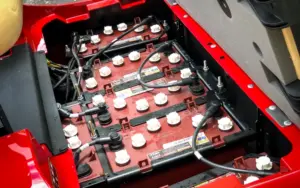
The number of batteries a golf cart needs depends on how its required system voltage and capacity are built. Traditional lead-acid carts usually combine several lower-voltage batteries in series: a 36V cart commonly uses six 6V batteries, while a 48V cart may use six 8V, four 12V, or eight 6V batteries.
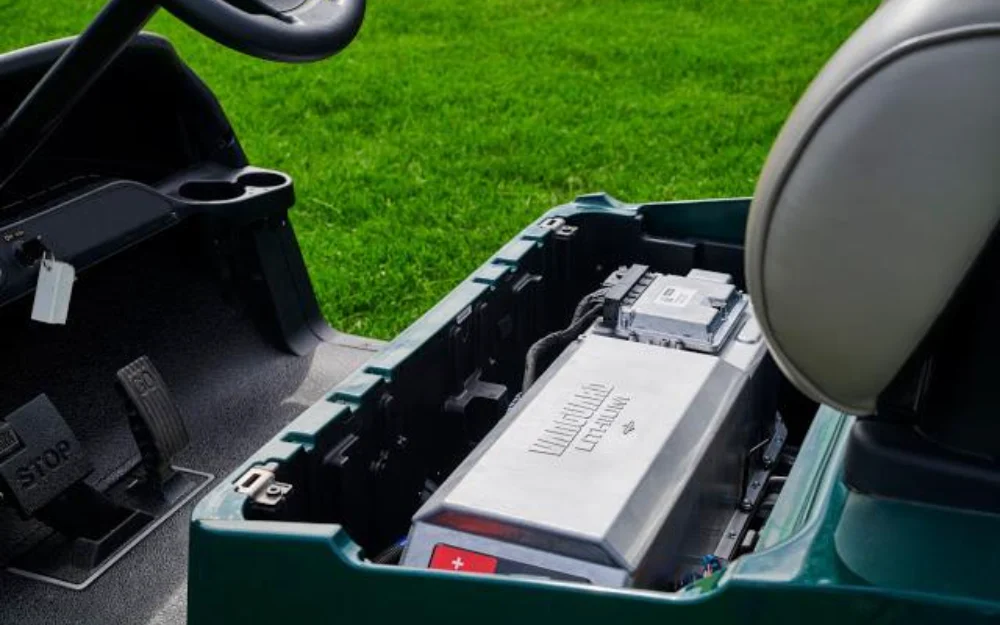
Lithium changes the physical architecture. A purpose-built 36V- or 48V-class lithium system may replace the entire multi-battery lead-acid bank with one integrated pack. However, not every lithium system uses one physical battery; some use multiple full-system-voltage modules connected in parallel. Battery count therefore tells only part of the story. System voltage, amp-hour capacity, stored energy, electrical configuration, and available installation space all matter.
Common 36V and 48V Golf Cart Battery Configurations
The simplest way to understand a traditional golf cart battery bank is to look at the system voltage and the voltage of each individual battery. Interstate Batteries documents six 6V batteries producing a 36V system, six 8V batteries producing a 48V system, and three 12V batteries producing a 36V system.
| System Voltage | Individual Battery Voltage | Typical Battery Count | Basic Configuration |
|---|---|---|---|
| 36V | 6V | 6 | Series |
| 36V | 12V | 3 | Series |
| 48V | 8V | 6 | Series |
| 48V | 12V | 4 | Series |
| 48V | 6V | 8 | Series |
| 36V / 48V Lithium | Full-system-voltage pack | Often 1, but not always | Integrated pack or parallel modules |
These are common architectures rather than universal rules. Club Car provides a useful real-world example. Its current Onward electric model uses six 8V flooded lead-acid batteries for its 48V electric configuration. Other Club Car commercial vehicles use eight 6V flooded lead-acid batteries to create a 48V system.
So a statement such as “this is a 48V golf cart” does not tell you how many individual batteries are installed. You also need to know the voltage and architecture of those batteries.
How Series Wiring Builds a 36V or 48V Battery Bank
Traditional golf cart battery banks commonly use a series connection to raise voltage. In a simple series string, the positive terminal of one battery is electrically connected to the negative terminal of the next, allowing their voltages to add together.
Battery University explains that adding batteries in series increases total voltage while the amp-hour capacity remains the same.
Consider six 6V batteries rated at 225Ah each:
- 6 × 6V = 36V system voltage
- System capacity remains 225Ah
- Nominal stored energy is approximately 36V × 225Ah = 8.1kWh
The six batteries do not create a 1,350Ah pack. Their voltages are being added in series; their Ah ratings are not.
The same principle applies to a 48V bank made from six 8V, 170Ah batteries:
- 6 × 8V = 48V
- System capacity remains 170Ah
- Nominal stored energy is approximately 48V × 170Ah = 8.16kWh
Interstate Batteries publishes these same 36V/225Ah and 48V/170Ah series-bank examples in its application guide.
This is the practical reason a golf cart may contain six physical batteries without having six times the capacity shown on each battery label.
Battery Count Does Not Tell You How Much Energy the Cart Has
Counting battery cases is useful for identifying the physical layout, but it does not tell you the total energy available to the vehicle.
Three values need to be kept separate:
- Voltage describes the electrical potential of the system.
- Amp-hours describe electrical charge capacity.
- Watt-hours or kilowatt-hours describe stored energy by combining voltage and capacity.
A simple nominal-energy calculation is:
Nominal Energy (Wh) = Voltage × Amp-hours
This creates an interesting comparison. A six-battery 36V/225Ah bank contains approximately 8.1kWh of nominal energy. A six-battery 48V/170Ah bank contains approximately 8.16kWh. Both systems contain six physical batteries, yet their voltage and Ah ratings are quite different while their nominal energy is similar.
That is why questions such as “Does a six-battery cart have more capacity than a four-battery cart?” cannot be answered by battery count alone.
Battery count also does not directly determine driving range, acceleration, or whether a 36V or 48V system is better for a particular cart. Those depend on the complete battery and vehicle system and belong to separate performance decisions.
How Lithium Changes the Golf Cart Battery Layout
A traditional flooded lead-acid bank distributes the system across several separate battery cases. The vehicle therefore needs multiple tray positions, interconnect cables, hold-down hardware, and exposed external connections between batteries.
An integrated lithium pack can move much of that architecture inside one enclosure. The pack may contain its cells, internal series and parallel connections, battery management system, protection electronics, main terminals, and mechanical structure as one assembled battery system.
Integrated full-voltage packs are already used in the golf cart market. Trojan, for example, has expanded its OnePack platform with dedicated 36V and 48V lithium pack options designed for golf cart and related vehicle platforms.
This is the architecture people often mean when they say one lithium battery can replace six lead-acid batteries. However, “lithium equals one battery” is not a universal rule.
RELiON uses a different approach with its InSight system. Each InSight unit is already a full-voltage battery, and the manufacturer states that its 24V and 48V InSight batteries are designed to operate in parallel rather than being connected in series. Adding parallel modules increases Ah capacity while system voltage stays the same.
The current 48V InSight model, for example, is rated at 51.2V and 30Ah, with parallel connection supported for multiple modules while series connection is not supported.
The correct conclusion is therefore simple: a lithium conversion can reduce the number of physical battery units, sometimes to one integrated pack, but the required battery count still depends on the lithium product architecture.
Physical Layout Matters When Replacing a Multi-Battery Bank
Matching system voltage is only one part of converting a multi-battery lead-acid bank to lithium. The replacement battery also has to work mechanically and electrically with the vehicle.
Important integration checks include:
- battery-compartment length, width, and height;
- mounting and hold-down locations;
- terminal position and access;
- main cable length and routing;
- vehicle controller current requirements;
- charger voltage and charging profile;
- communication requirements where the vehicle uses battery, charger, display, or controller communication.
Manufacturers solve the packaging problem in different ways. RELiON’s InSight 48V, for example, uses a standard GC2-format enclosure and is designed so multiple 48V modules can occupy existing battery positions. Club Car takes another approach with its lithium systems, describing its pack as a fully enclosed, self-contained lithium-ion battery assembly.
An integrated golf cart battery solution should therefore be evaluated against the vehicle’s electrical requirements and available installation space. Replacing six battery cases with one enclosure changes the packaging, but it does not remove the need to confirm fit, charger compatibility, controller demand, and connection requirements.
How to Identify the Battery Configuration in Your Golf Cart
Do not identify a golf cart battery system by counting battery cases alone. Start with the vehicle’s specified system voltage, then inspect the ratings on the installed batteries.
A practical check should include:
- Confirm whether the vehicle is designed around a 36V, 48V, or another voltage system.
- Read the nominal voltage printed on each battery.
- Count the physical batteries or lithium modules.
- Determine whether they form a series, parallel, or combined configuration.
- Check the Ah rating and, where available, total Wh or kWh.
- Measure or confirm the available battery-tray dimensions before considering a different pack format.
- Confirm that the existing charger is appropriate for the proposed battery chemistry and voltage.
For example, seeing six batteries does not establish the system voltage. Six 6V batteries wired in series can form a 36V bank, while six 8V batteries can form a 48V bank.
If the battery labels, wiring architecture, or original vehicle specification are unclear, verify the configuration through the vehicle documentation or a qualified battery supplier before selecting a replacement.
Final Takeaway
The number of batteries a golf cart needs is a result of its pack architecture, not the defining specification. Traditional 36V and 48V lead-acid systems usually combine several lower-voltage batteries in series, while modern lithium systems may use one integrated full-voltage pack or several full-voltage modules in parallel. To understand or replace a golf cart battery bank correctly, look beyond the physical battery count. System voltage, Ah capacity, total energy, series or parallel architecture, charger compatibility, and installation space provide a much more complete picture of what the vehicle actually requires.
Frequently Asked Questions
Can a 48V golf cart use four 12V batteries?
Yes. Four compatible 12V batteries connected in series can create a nominal 48V bank. That does not mean four 12V batteries can automatically replace every existing 48V configuration; capacity, discharge capability, dimensions, charging requirements, and the vehicle manufacturer’s specifications still need to match.
Can one lithium battery replace six lead-acid golf cart batteries?
Yes, a purpose-built full-system-voltage lithium pack can replace a multi-battery lead-acid bank in a compatible vehicle. The lithium golf cart battery still needs to match the vehicle voltage, controller demand, charger, connection requirements, and available installation space.
Do batteries connected in series add their Ah ratings together?
No. In a series string, battery voltages add while the Ah capacity remains approximately equal to the capacity of one battery in the string. In a parallel configuration, voltage remains the same while Ah capacity increases.