Shipping drone lithium batteries internationally requires more than having a single certificate. OEM buyers need to verify the exact battery model, its UN 38.3 transport status, watt-hour rating, shipment configuration, transport mode, state of charge, required dangerous-goods documentation, and carrier acceptance before freight is booked.
A battery shipped by itself may follow different rules from the same battery packed with or installed in a drone. Air and sea freight also use different regulatory frameworks. This article reflects the international rules in force in 2026, including the 67th Edition of the IATA Dangerous Goods Regulations. Requirements change, and individual States, airlines, shipping lines, and freight forwarders may impose additional conditions, so the final shipment should always be checked against the rules in force when it is booked.
Start With the Shipment Configuration, Not the Destination Country
Before asking whether a drone battery can be shipped to a particular country, first establish how the battery will be offered for transport. Under the 2026 IATA air-transport framework, rechargeable lithium-ion batteries generally fall into different classifications depending on whether they are shipped alone, packed with equipment, or contained in equipment.
| Shipment Configuration | Typical Air Classification | Main Buyer Concern |
|---|---|---|
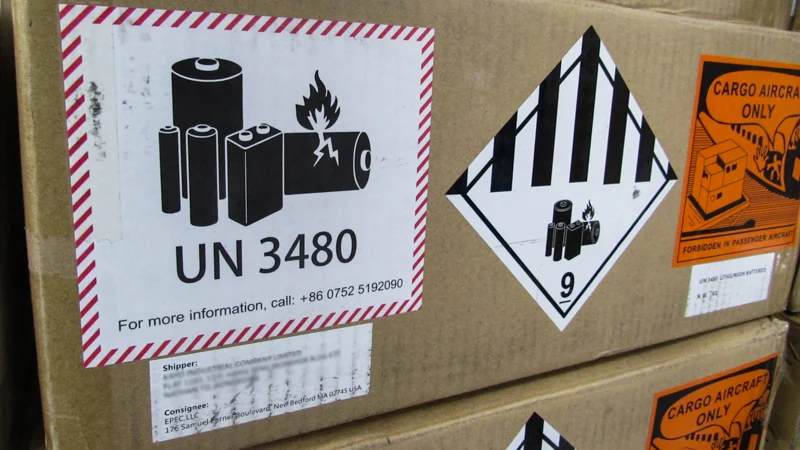
| Battery shipped by itself | UN 3480 / PI 965 | Cargo-aircraft restrictions, state of charge, Wh rating and packaging |
| Battery packed with the equipment it powers | UN 3481 / PI 966 | Battery size, state of charge and applicable section |
| Battery installed in equipment | UN 3481 / PI 967 | Different packing and state-of-charge provisions may apply |
IATA’s 2026 guidance classifies standalone lithium-ion batteries as UN 3480, while batteries packed with or contained in the equipment they power may fall under UN 3481.
That distinction should not be made casually. Placing a battery in the same carton as cables, a charger, or an AC adaptor does not automatically make it “packed with equipment.” The applicable equipment must be the device the battery is intended to power.
For an OEM inquiry, provide the supplier and dangerous-goods forwarder with the exact battery model, nominal voltage, rated capacity, watt-hour rating, number of packs, intended shipment configuration, and preferred transport mode.
What UN 38.3 Actually Tells an OEM Buyer
UN 38.3 is the starting point for lithium-battery transport, but buyers should understand what the requirement actually means.
The current UN Manual of Tests and Criteria includes subsection 38.3 covering the transport testing of lithium cells and batteries. IATA’s 2026 classification guidance likewise states that lithium cell and battery types offered for normal air transport must have passed the applicable UN 38.3 tests.
For procurement purposes, an important document is the UN 38.3 test summary. It identifies information such as the manufacturer, test laboratory, test-report number, battery description, model numbers, watt-hour rating, tests conducted, and the edition of the UN Manual used.
Manufacturers and subsequent distributors are required to make this test summary available for applicable battery types. However, IATA notes that a paper copy of the test summary does not normally have to accompany every shipment unless a State or operator specifically requires it.
OEM buyers should therefore ask for evidence that matches the actual finished battery model, not simply a generic document from the component-cell manufacturer.
This is particularly important for custom battery packs. U.S. PHMSA interpretations of the UN 38.3 framework make clear that tested component cells do not automatically remove the testing requirement for a new electrically connected battery design. A custom UAV pack should therefore have its own transport status confirmed rather than assuming cell-level documentation covers the finished configuration.
Air Freight Has the Tightest Restrictions
Air shipment deserves particular attention because the applicable rules vary with battery size and shipment configuration.
For standalone lithium-ion batteries under PI 965, the 2026 IATA classification flowchart separates batteries above and below the 100Wh threshold. standalone batteries above 100Wh fall under Section IA, while batteries up to 100Wh may fall under Section IB, subject to the other applicable conditions.
Standalone UN 3480 batteries are normally restricted to cargo aircraft. They must also be offered for transport at a state of charge not exceeding 30% of rated capacity unless the applicable State approvals are obtained.
Watt-hour rating therefore matters well before freight is booked. IATA defines it as:
Watt-hours = nominal voltage × rated capacity in amp-hours
A 22.2V, 10Ah UAV battery, for example, has a nominal energy rating of 222Wh. That places it well above the 100Wh threshold used in the air-shipping classification flowchart for lithium-ion batteries.
The 30% rule should not, however, be turned into the statement that every lithium-ion battery in every shipment must always be below 30% SoC.
Beginning in 2026, PI 966 also applies a 30% SoC limit to lithium-ion batteries packed with equipment under Section I and to Section II batteries above 2.7Wh under the normal provisions. Batteries contained in equipment under PI 967 are treated differently: IATA strongly recommends a reduced state of charge, but the same blanket mandatory limit does not apply under the normal provision.
Airline acceptance is another separate issue. States and operators can publish requirements that are more restrictive than the baseline IATA rules. A technically compliant battery shipment can therefore still require additional conditions or be refused by a particular airline.
Air and Sea Freight Are Different Compliance Routes
When air freight becomes difficult or commercially unattractive, sea freight may be an alternative. That does not mean the same air-shipping rules can simply be copied onto an ocean shipment.
International air cargo is governed through the ICAO Technical Instructions and implemented commercially through frameworks such as the IATA Dangerous Goods Regulations. Ocean dangerous-goods transport uses the International Maritime Dangerous Goods Code.
For sea shipments in 2026, the International Maritime Organization states that the IMDG Code 2024 Edition incorporating Amendment 42-24 became mandatory on 1 January 2026.
The battery still needs the correct transport classification and applicable UN 38.3 status, but packaging, documentation, marks, quantity provisions, and carrier procedures must be checked against the maritime rules rather than an air packing instruction.
This is why transport mode should be discussed before production and dispatch. For an OEM program involving recurring battery orders, freight method can affect packaging plans, lead time, dangerous-goods handling, and the practical way finished packs move through the supply chain.
What Documents Should OEM Buyers Ask About?
A good battery sourcing process separates product evidence from shipment-specific documents. They are related, but they are not interchangeable.
| Document or Information | Why It Matters | Important Caveat |
|---|---|---|
| UN 38.3 Test Summary | Shows transport-test information for the relevant battery type | Confirm that it matches the actual battery model or applicable design type |
| Battery Specification / Wh Rating | Supports classification and freight planning | Voltage and rated capacity must match the shipment |
| IEC 62133-2 Documentation, where applicable | Provides product-safety evidence for applicable portable rechargeable lithium batteries | It does not replace UN 38.3 transport testing |
| SDS / MSDS, if requested | May be requested by a customer, carrier, forwarder, or internal process | It is not a universal lithium-battery transport document |
| Dangerous Goods Declaration, where required | Describes the shipment for regulated dangerous-goods transport | Confirm who is qualified and responsible for preparing and signing it |
| Packing, Marking and Labeling Confirmation | Confirms how the actual shipment will be prepared | Requirements depend on classification, mode, quantity and carrier |
The SDS point deserves clarification. IATA’s 2026 guidance states that an SDS is not itself a transport document and is not universally required simply to offer batteries for transport. A forwarder or customer may still request one operationally, but it should not be confused with a UN 38.3 test summary.
IEC 62133-2 is also a different requirement. The IEC describes it as a standard covering safety requirements and tests for portable sealed rechargeable lithium cells and batteries under intended use and reasonably foreseeable misuse. It does not replace transport testing under UN 38.3.
Document availability should always be confirmed for the exact model being purchased. This is especially important for standard and custom lithium-ion battery packs, where changes in voltage, capacity, cell arrangement, enclosure, or electrical configuration can affect the finished battery design.
A Practical Pre-Shipment Check for OEM Buyers
The most effective way to avoid last-minute logistics problems is to treat battery sourcing and freight planning as one process.
- Lock the exact battery model. Do not plan dangerous-goods transport around a generic description such as “6S drone battery.”
- Confirm the watt-hour rating. The forwarder needs the actual nominal voltage and rated capacity of the finished pack.
- Confirm UN 38.3 status. Ask whether the relevant finished battery type has applicable transport-test evidence and whether the test summary can be supplied.
- Define how the battery will ship. Standalone, packed with equipment, and contained in equipment can lead to different requirements.
- Choose air or sea early. Each mode follows a different dangerous-goods framework.
- Confirm shipment-specific documentation and preparation. Work with a qualified dangerous-goods forwarder on declarations, packaging, marking, labeling, quantity limits, and operator requirements.
- Obtain carrier acceptance before dispatch. This is particularly important for high-Wh standalone packs, unusual configurations, prototypes, and larger quantities.
For custom development, transport should be considered alongside battery cell selection and integration. Changing cell count, voltage, capacity, or pack architecture can change the finished battery’s watt-hour rating and may also affect its transport design type.
OEM buyers should therefore avoid treating logistics as something that begins only after the battery is manufactured. A pack that meets the UAV’s electrical requirements still needs a practical and compliant route into the destination market.
Final Takeaway
International drone-battery shipping starts with the exact battery model and shipment configuration, not with a generic claim that the battery is “certified.” UN 38.3 transport evidence is essential, but correct classification, watt-hour rating, state-of-charge rules, packaging, shipment documentation, transport mode, and carrier acceptance all affect whether the consignment can move.
The rules also change. This article reflects the 2026 framework, so OEM buyers should confirm the current IATA/ICAO or IMDG requirements, State variations, and carrier policies when each shipment is booked. Supplier documentation should likewise be verified for the exact battery model rather than assumed across an entire product range.
FAQ
Is an SDS or MSDS enough to ship a drone lithium battery?
No. An SDS may be requested by a customer, carrier, forwarder, or internal process, but it does not replace UN 38.3 transport evidence or shipment-specific dangerous-goods documentation.
Can a drone battery above 100Wh be shipped internationally?
Potentially, yes. Higher-energy packs are subject to more restrictive provisions in some transport configurations, particularly by air, so classification, packaging, aircraft eligibility, documentation, and carrier acceptance must be confirmed for the actual shipment.
Does UN 38.3 testing of the cells automatically cover a custom drone battery pack?
No assumption should be made. A finished electrically connected battery can constitute its own battery design type, so the applicable UN 38.3 status of the completed pack should be confirmed rather than inferred only from the component-cell documentation.
Is IEC 62133-2 the same as UN 38.3?
No. IEC 62133-2 addresses safety requirements for applicable rechargeable lithium cells and batteries in intended use and foreseeable misuse. UN 38.3 addresses testing associated with transport, so one should not be treated as a substitute for the other.