Golf cart batteries do not have one fixed replacement age. Well-maintained lead-acid batteries are commonly used for 4~5 years, while LiFePO₄ batteries generally offer much higher cycle-life potential and may remain in service considerably longer. Actual life, however, depends on more than battery chemistry.
The useful service life of a battery is shaped by two processes: aging caused by charge-discharge cycles and aging that occurs simply with time. Depth of discharge, temperature, charging conditions, vehicle load, and maintenance can accelerate either process. For this reason, the best replacement point is not a specific birthday. It is the point at which the battery can no longer provide the capacity and power required for the cart’s normal duty cycle.
How Long Do Golf Cart Batteries Usually Last?
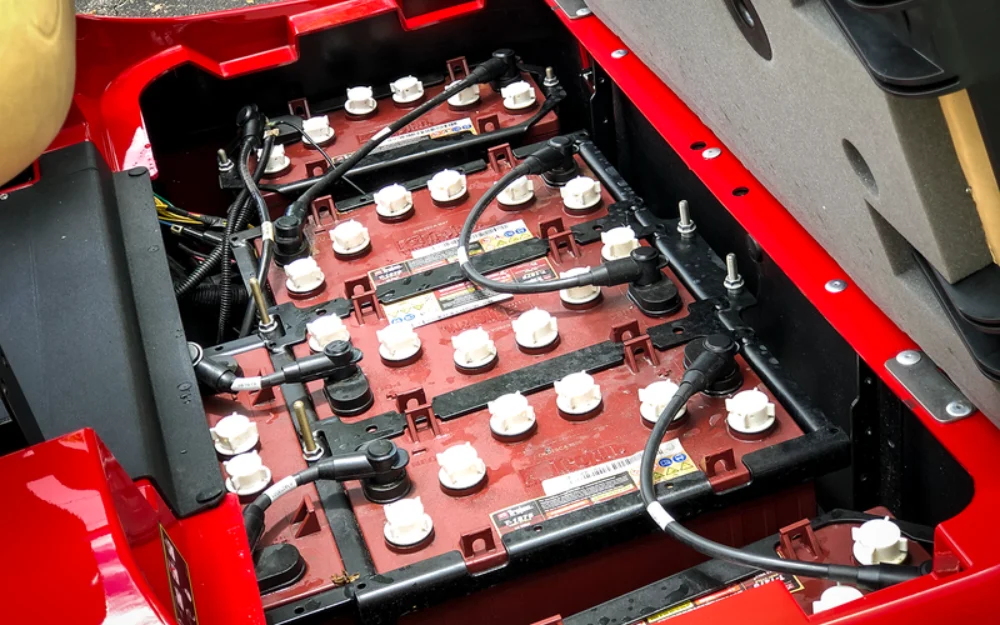
For conventional flooded lead-acid batteries, several years of usable service is a reasonable expectation when charging and maintenance are handled correctly. Interstate Batteries, for example, states that well-maintained lead-acid golf cart batteries typically last four to six years. That figure should be treated as a practical reference rather than a guaranteed lifespan.
Lithium batteries, particularly LiFePO₄ packs designed for deep-cycle vehicle use, can have a substantially longer cycle-life potential. Trojan Battery notes that its own lithium golf-cart products are designed around long cycle life and states that its OnePack products have an expected life measured in thousands of cycles and potentially ten years or more when used within its specified conditions. Again, that is a product-specific expectation, not a universal rule for every lithium battery.
| Factor | Lead-Acid | LiFePO₄ |
|---|---|---|
| Typical service-life pattern | Several years with proper maintenance | Higher long-term cycle-life potential |
| Effect of deep discharge | Strong | Still important, though usually better tolerated |
| Routine maintenance | Important for flooded batteries | Generally lower |
| Replacement timing | Strongly affected by maintenance and cycling | Driven by capacity fade, aging, and operating conditions |
The main point is that chemistry defines the battery’s durability potential, but operating conditions determine how quickly that potential is consumed. A golf cart battery solution should therefore be evaluated using its actual cycle-life conditions, discharge requirements, charging limits, and expected vehicle duty rather than a lifespan claim alone.
Cycle Life and Calendar Life Are Not the Same
A battery can age in two different ways. Cycle aging is associated with repeated charging and discharging. Calendar aging happens over time even while the battery spends long periods parked or stored.
This distinction matters because two carts of the same age may have very different battery conditions. A commercial cart used every day may accumulate cycles quickly. A privately owned cart used only on weekends may complete far fewer cycles, but its battery continues to experience calendar aging between trips.
Laboratory research on commercial graphite/LiFePO₄ cells has demonstrated that capacity fade during storage increases strongly with temperature and is also influenced by state of charge. A later study of commercial LFP cells likewise found that temperature and storage state of charge affect degradation over time.
This means low usage does not automatically guarantee exceptionally long battery life. Fewer cycles can reduce cycle-related wear, but time and storage conditions continue to matter. In hot environments, calendar aging may become particularly important even when annual mileage is low.
What Actually Shortens Golf Cart Battery Life?
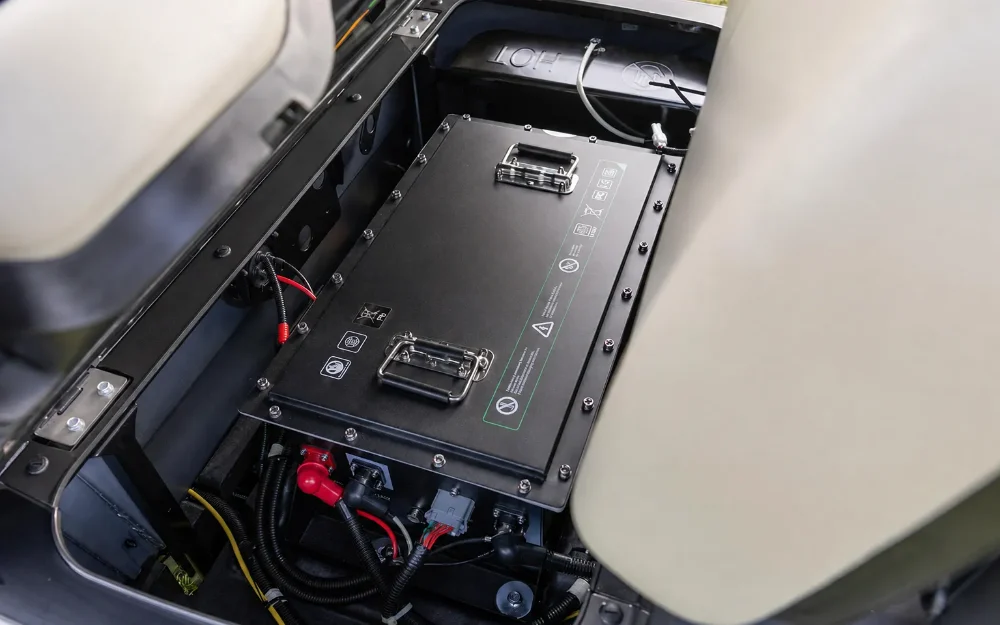
Battery age alone explains very little. Depth of discharge, temperature, charging behavior, and vehicle duty can cause two otherwise similar batteries to reach replacement condition at very different times.
Depth of Discharge
Depth of discharge, or DOD, describes how much of the battery’s available capacity is used before recharging. Repeated deeper discharges generally reduce the number of cycles a battery can deliver compared with shallower cycling.
The effect can be seen in manufacturer data for both battery types. U.S. Battery’s deep-cycle data shows approximately 1,475 expected cycles around 40% DOD versus about 675 cycles around 80% DOD for its referenced flooded deep-cycle batteries. These numbers apply to that manufacturer’s products, but they illustrate why DOD must be considered when comparing lifespan claims.
The same principle applies to LiFePO₄. Shallower cycling can increase the number of usable cycles, although the exact relationship depends on cell design, pack configuration, temperature, and the manufacturer’s test method.
Operating and Storage Temperature
Temperature affects both immediate battery performance and long-term aging. High temperatures can accelerate chemical degradation, while extreme cold can reduce available performance and create charging limitations depending on the chemistry.
For long-term service life, heat deserves particular attention. The LFP calendar-aging study discussed above found substantially greater capacity loss at higher storage temperatures. For a golf cart that spends long periods parked outdoors, in an unconditioned storage building, or in a hot climate, storage environment can matter even when the cart is not used intensively.
Charging Habits
A battery should be charged using equipment and settings appropriate for its chemistry and voltage. Lead-acid batteries can suffer when repeatedly left undercharged, while flooded designs also require correct maintenance and water levels. Lithium packs depend on compatible charging voltage, current limits, temperature conditions, and battery-management protection.
The goal is not simply to charge as quickly or as often as possible. It is to keep the battery within the manufacturer’s defined operating window. Using an unsuitable charger or repeatedly operating outside specified charging conditions can reduce useful life and, in some cases, create safety or reliability problems.
Vehicle Load and Duty Cycle
A lightly loaded cart driven occasionally on level ground does not impose the same duty as a fleet vehicle carrying passengers throughout the day, climbing grades, or operating under repeated acceleration.
Higher load can increase discharge current, heat generation, and the amount of capacity consumed per trip. More intensive use can also produce more full-equivalent cycles in the same calendar period. For fleet operators, the important question is therefore not simply how old the battery is, but how much work it performs during that time.
How to Read a Golf Cart Battery Cycle-Life Rating
A statement such as “3,000 cycles” is incomplete unless the test conditions are also known. At minimum, buyers should look for the specified depth of discharge and the capacity threshold used to define the end of cycle life.
Victron Energy provides a clear example in its LiFePO₄ technical documentation. Its Lithium NG batteries are rated at 2,500 cycles at 80% DOD, 3,000 cycles at 70% DOD, and 5,000 cycles at 50% DOD, with cycle life defined at at least 80% of nominal capacity remaining. Those figures describe Victron’s products, not all LiFePO₄ batteries, but they show why cycle count cannot be separated from test conditions.
Reaching the rated cycle-life endpoint also does not mean a battery suddenly stops working on the next cycle. If the rating uses 80% remaining capacity as its endpoint, the battery may still operate after that threshold. The question is whether its reduced capacity and power remain sufficient for the application.
Lithogenix’s current LiFePO₄ golf cart battery platforms, for example, are specified at more than 3,000 cycles at 80% DOD. That figure is most useful when evaluated together with the vehicle’s load, expected daily cycling, charging conditions, and required service window rather than interpreted as a guaranteed number of years.
When Should a Golf Cart Battery Be Replaced?
A golf cart battery reaches the practical end of its service life when its remaining capacity or power can no longer reliably meet the cart’s normal operating requirement. Calendar age by itself is not enough to make that decision.
Common signs that a battery should be assessed for replacement include:
- noticeably shorter usable operating time than the vehicle previously delivered;
- inability to complete the normal daily route or work cycle;
- increasingly weak performance under normal acceleration or load;
- repeated charging, imbalance, or battery-management problems;
- physical deterioration or a confirmed failure during battery testing.
The acceptable threshold depends on the application. A privately owned cart used for short neighborhood trips may remain useful after noticeable capacity loss. A resort, golf course, or utility fleet may need to replace the same battery earlier because the vehicle must reliably complete a full working schedule.
This is why service life should be treated as an application requirement rather than a universal number. The battery does not need to be completely unusable before replacement becomes commercially justified.
Final Takeaway
Golf cart battery life is determined by more than chemistry or age. Lead-acid and LiFePO₄ batteries have different cycle-life potential, but actual service life reflects the combined effects of cycling, calendar aging, depth of discharge, temperature, charging conditions, and vehicle load. When comparing batteries, look beyond a headline cycle number and check the conditions behind it. Replacement becomes necessary when the battery can no longer deliver the capacity and power required by the cart’s real duty cycle—not simply when it reaches a predetermined number of years.
Frequently Asked Questions
Does a golf cart battery last longer if the cart is rarely used?
Fewer charge-discharge cycles can reduce cycle-related aging, but the battery still experiences calendar aging while parked. Storage temperature, state of charge, and general storage conditions continue to influence long-term capacity.
Is the battery warranty the same as its expected service life?
No. A warranty is a manufacturer’s commercial coverage period with defined terms and conditions. It should not be interpreted as a precise prediction of when the battery will reach the end of its usable life.
Can a lithium golf cart battery still work after reaching its rated cycle life?
Yes. Cycle-life ratings commonly use a remaining-capacity threshold rather than complete failure. A battery may continue operating beyond that point, but whether it should remain in service depends on whether its remaining capacity and power still meet the cart’s operating requirements.