For a drone or UAV, discharge capability matters first as a minimum requirement; energy density becomes the priority once the battery can already support the aircraft’s continuous and peak loads. A battery with excellent Wh/kg is not useful if voltage collapses during takeoff, climb, or heavy-load hover. But choosing far more discharge capability than the aircraft needs can add unnecessary weight or sacrifice stored energy that could have extended flight time.
The better engineering approach is therefore not to choose a “high-discharge” or “high-energy” battery by label. Define the mission power profile, eliminate cells that cannot satisfy it, then compare the remaining options by usable energy, pack weight, volume, and integration requirements.
Energy Density and Power Capability Solve Different Problems
Energy and power describe two different battery capabilities. Battery University distinguishes energy density as the amount of energy a battery can hold and power density as how much power it can deliver on demand. For UAV engineering, that distinction is fundamental.
For weight-sensitive aircraft, the most useful energy metric is usually Wh/kg. Strictly speaking, Wh/kg is specific energy, while volumetric energy density is expressed in Wh/L. In practical battery discussions, however, “energy density” is often used broadly for both.
Higher Wh/kg allows an aircraft to carry more stored energy for the same battery mass. That can improve:
- flight endurance;
- range;
- payload margin;
- the amount of the aircraft’s total mass devoted to useful energy.
Power capability answers a different question: can the battery deliver energy quickly enough when the propulsion system demands it? This matters during takeoff, climb, rapid acceleration, high-throttle maneuvering, heavy-payload hover, and other high-load phases.
A high-energy battery is therefore not automatically a good endurance battery if it cannot support the aircraft’s required current. Likewise, a battery with exceptionally high discharge capability may be unnecessary when the aircraft spends most of its mission at a modest, steady cruise load.
Why Higher Power and Higher Energy Often Trade Against Each Other
High-energy and high-power cells are not simply different capacity versions of the same design. The tradeoff exists inside the cell itself.
A 2026 EES Batteries study explains that high-energy lithium-ion cells benefit from thicker electrodes, while high-power designs benefit from thinner electrodes. Thick electrodes can hold more active material, but ions must travel farther through the electrode during high-rate operation. Thinner electrodes reduce that transport limitation and can support faster energy delivery.
Other design decisions matter as well. The RSC perspective on electric-aircraft cell selection notes that cell features that improve high-power operation can impose penalties on gravimetric energy density. Current collectors, tab design, internal resistance, thermal behavior, and electrode architecture all influence where a cell sits on the energy-power spectrum.
A useful real-world comparison comes from two cells with the same 21700 form factor. Molicel’s M65A is rated at 6.5Ah, 322Wh/kg, and 26A discharge current. The manufacturer’s P45B power cell is rated at 4.5Ah, 242Wh/kg, and 45A discharge current.
These two products should not be treated as a universal rule for all lithium-ion cells. They do demonstrate the engineering tradeoff clearly: the same cylindrical format can be optimized toward more stored energy or toward greater current capability.
This is why UAV cell selection should not begin with chemistry or form factor alone. It should begin with what the aircraft actually needs the battery to do.
The Mission Profile Decides Which Requirement Becomes Critical
Different UAVs can use similar battery technologies yet impose very different electrical loads. The important variable is the mission profile: how much power the aircraft needs during each phase, and for how long.
| UAV Mission | Main Battery Priority | Why |
|---|---|---|
| Mapping & Survey | Energy density | Long cruise or loiter time usually dominates the mission |
| Inspection & Monitoring | Energy density with sufficient power margin | Endurance matters, but maneuvering and takeoff still require current |
| Heavy-Lift & Cargo | Power capability | Payload can create sustained high propulsion demand |
| Agricultural Spraying | Power capability plus usable energy | Heavy payload and repeated high-load operation demand both |
| High-Speed UAV | Power capability | Acceleration and high-throttle operation require strong current delivery |
| VTOL / Fixed-Wing Hybrid | Both | Vertical phases are power-intensive while cruise rewards higher energy density |
Electric vertical-flight research illustrates this distinction well. A typical eVTOL mission includes takeoff, climb, cruise, descent, and landing, and takeoff and landing impose the highest power requirements while gravimetric energy density remains critical to aircraft range.
The same reasoning applies at smaller UAV scale, although the actual current values depend on the aircraft.
A fixed-wing VTOL platform may need very high power for only a short vertical launch and landing period. Once it transitions to efficient forward flight, energy density becomes much more important. A heavy-lift multirotor is different: maintaining hover with a payload can remain a high-current condition for much of the mission.
This distinction between peak power and sustained power matters. A cell capable of a brief high-current pulse is not automatically suitable for maintaining that current throughout a long hover or spraying cycle.
The mission should therefore be broken into load phases rather than reduced to a label such as “inspection drone” or “cargo drone.” Battery requirements follow the actual propulsion load, payload, duration, and operating conditions.
Why C-Rating Alone Is a Poor Selection Method
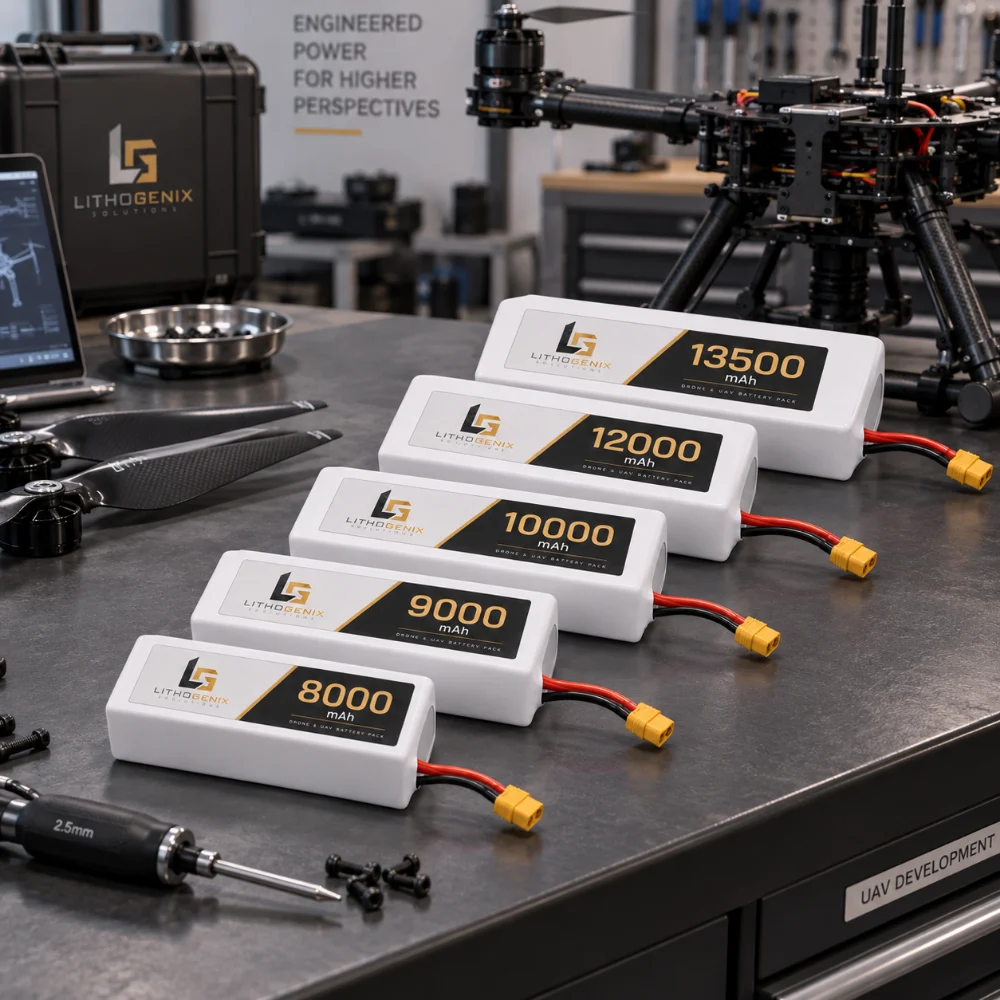
C-rating is useful only after it is converted into actual current. It should not be the primary way to compare drone batteries.
A 10C rating means the discharge current is ten times the rated amp-hour capacity. That means:
- a 2Ah battery at 10C corresponds to 20A;
- a 5Ah battery at 10C corresponds to 50A.
The same C-number can therefore represent very different electrical capability.
More importantly, a current rating does not tell the entire story. Under high load, internal resistance causes voltage drop and heat generation. A battery may technically deliver the requested current while its voltage falls enough to reduce propulsion performance or reach the system’s low-voltage threshold earlier than expected.
Duration also matters. A short peak during takeoff is different from a continuous high-current hover. Cell temperature, state of charge, cooling conditions, and pack configuration all influence how much current can be sustained safely.
A more useful UAV selection sequence is:
aircraft current demand → duration of that demand → cell current capability → voltage under load → thermal margin
Only after those requirements are satisfied should energy density become the dominant comparison metric.
How to Choose the Right Balance for a UAV Battery Pack
The most reliable selection process starts with the mission rather than with a cell datasheet. A useful engineering workflow can be reduced to six steps.
1. Map the Mission Profile
Separate the flight into meaningful phases such as takeoff, climb, cruise, hover, payload operation, descent, and landing. Estimate how long each phase lasts and which phases create the greatest electrical demand.
2. Define Continuous Current
Determine the current the battery must sustain for the longer high-load sections of the mission. This can be especially important for heavy-lift multirotors, spraying platforms, and aircraft that spend long periods hovering.
3. Define Peak Current and Duration
Identify short-duration loads caused by takeoff, acceleration, aggressive maneuvering, or temporary payload operation. Peak current without duration is incomplete information: a ten-second requirement and a ten-minute requirement should not be treated as equivalent.
4. Set the Minimum Power Requirement
Eliminate cells and pack configurations that cannot meet the required continuous current, peak current, voltage-under-load, and thermal conditions with appropriate design margin.
At this stage, power capability acts as a screening threshold. A cell that fails this threshold should not remain in contention simply because its Wh/kg is attractive.
5. Optimize Energy Among the Cells That Pass
Once multiple candidates satisfy the power requirement, compare their usable energy, Wh/kg, weight, volume, and expected cell count. This is where an energy-oriented cell can deliver a meaningful endurance advantage.
Conversely, selecting a much higher-discharge cell than the aircraft requires may provide little practical benefit if the tradeoff is less stored energy for the same battery mass.
6. Recheck the Result at Pack Level
A cell specification is not a finished UAV battery. Parallel groups can increase available current, but they also increase cell count, weight, interconnections, and volume. Thermal behavior and current per cell can also change once the complete pack architecture is defined.
The final comparison should therefore be made between finished pack concepts, not between isolated cell specifications. Lithogenix applies this same system-level approach to battery cell selection and integration, where cell capability has to be evaluated together with the electrical and mechanical requirements of the complete battery pack.
Final Takeaway
High-discharge capability matters first when the UAV’s mission creates demanding electrical loads, because a battery that cannot support the required current is not a viable option. Once that minimum power requirement is satisfied, energy density becomes the more valuable optimization target for flight endurance, battery mass, and payload margin.
The best drone battery is therefore neither the cell with the highest C-rating nor the one with the highest Wh/kg in isolation. It is the pack that meets the aircraft’s complete power profile while carrying as little unnecessary battery mass as possible.
FAQ
Does a high-discharge drone battery always have lower capacity?
No. Modern cells can combine substantial energy and power capability, but cell design still involves tradeoffs between the two. Compare actual Wh/kg, current capability, resistance, and pack requirements rather than assuming every high-power cell has low capacity.
Can a high-energy battery still be used in a high-power drone?
Yes, if the selected cell and pack configuration meet the aircraft’s continuous and peak current requirements. Adding parallel cells can increase current capability, but doing so also increases pack weight, volume, and cell count.
Does a higher C-rating mean a better drone battery?
No. C-rating must be converted into actual amps and does not by itself describe voltage sag, thermal behavior, or usable energy. The aircraft’s real load profile should determine how much discharge capability is actually required.
Should I choose the highest Wh/kg cell once current requirements are met?
It is a useful starting point, but the final decision should still be made at pack level. Parallel configuration, thermal design, cell count, mechanical integration, and usable energy can change the advantage seen in a cell datasheet.