Neither LiPo nor Li-ion batteries is universally better for drones. LiPo is usually the stronger starting point when a UAV needs high peak current, rapid acceleration, or heavy-load takeoff, while Li-ion is often more attractive when usable energy and flight endurance are the priority.
That distinction is useful, but it is not enough to specify a battery pack. Modern high-power Li-ion cells can deliver far more current than older rules of thumb suggest, and a finished UAV battery behaves differently from an individual cell.
The right choice therefore starts with the aircraft mission: continuous current, peak current, target flight time, payload, battery weight, available space, and pack voltage. The chemistry should follow those requirements—not replace them.
LiPo vs Li-ion: The Practical Difference for UAVs
In drone discussions, “LiPo” and “Li-ion” are often treated as two completely separate battery chemistries. That is an oversimplification.
Modern lithium-polymer cells belong to the broader lithium-ion family. Battery University notes that Li-polymer can use several lithium-ion electrode systems and is not a unique chemistry by itself. In practical product discussions, pouch cells are frequently described as Li-polymer, while conventional Li-ion drone packs often use cylindrical 18650 or 21700 cells.
For UAV engineers, that practical distinction matters more than the terminology.
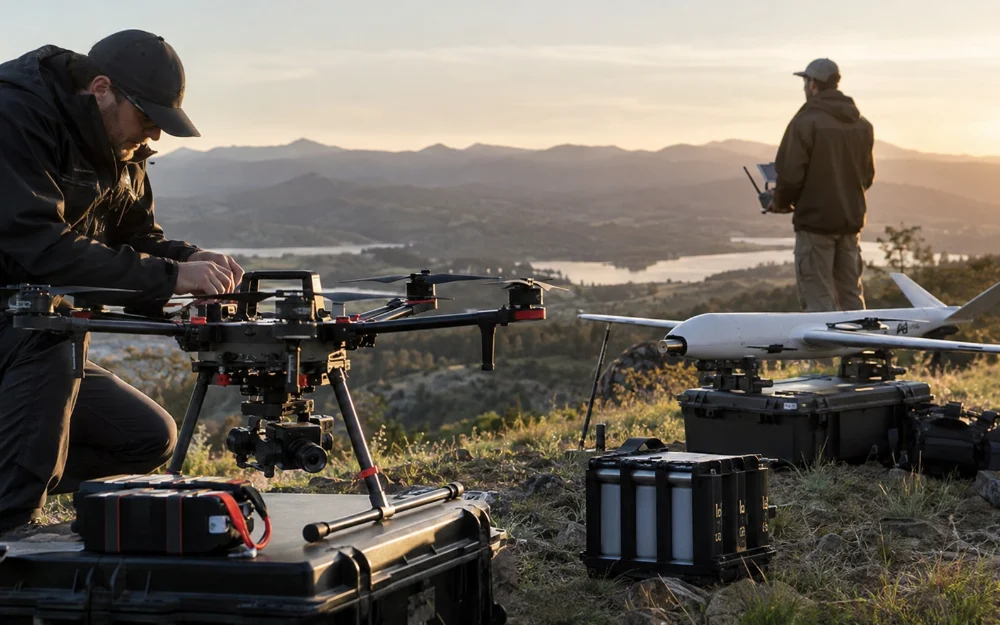
LiPo drone batteries are commonly built as lightweight pouch packs with strong discharge capability. They suit aircraft that demand substantial current during takeoff, aggressive climbing, rapid maneuvering, or other high-load events.
Li-ion UAV batteries often use cylindrical cells and are commonly selected when usable energy and endurance are more important than extreme burst performance. Long-range drone builders, for example, frequently use 18650 or 21700 packs because they can store more usable energy for the same approximate battery mass, provided the aircraft does not exceed the cells’ current capability. Long-range FPV applications illustrate this energy-versus-current trade-off clearly.
That leads to the more useful engineering question:
Does the mission demand more power, more energy, or a carefully designed balance of both?
Power or Energy: What Does the UAV Mission Actually Require?
A drone battery has to satisfy two different requirements.
Power determines whether the battery can support the aircraft during its most demanding flight conditions.
Energy determines how long the battery can continue supplying that power.
A UAV can therefore have plenty of stored energy and still be poorly matched if the cells cannot safely supply the required current.
High-power conditions can include:
- Heavy-payload takeoff
- Rapid climb
- Sudden acceleration
- High-throttle maneuvering
- Strong wind correction
- Demanding multirotor propulsion systems
These conditions tend to favor battery packs with strong peak-current capability and limited voltage drop under load. High-rate LiPo packs are commonly used for this reason.
By contrast, an inspection, mapping, survey, or long-range aircraft may spend much of its mission at a relatively steady power level. If its continuous and peak current stay within the chosen cells’ capability, a Li-ion pack can make better use of its higher stored energy and support longer operating periods.
A UAV power-system review published in Applied Sciences identifies specific energy, energy density, and specific power as important battery-selection parameters for a given aircraft and mission. It also notes that endurance is constrained by the weight of the battery system itself. The review discusses these trade-offs across UAV power-source architectures.
The practical implication is simple:
Peak current tells you whether a battery architecture can support the mission. Usable energy helps determine how long the aircraft can perform it.
| Decision Factor | LiPo | Li-ion | Why It Matters |
|---|---|---|---|
| Peak Current | Generally a strong fit | Depends heavily on cell selection | Takeoff, climb, and rapid acceleration |
| Usable Energy | Often secondary to power | Often a key advantage | Endurance and mission duration |
| Voltage Under High Load | High-rate packs can perform well | Depends on cell resistance and pack design | Propulsion stability |
| Form Factor | Flexible pouch construction | Commonly cylindrical 18650 / 21700 | Airframe packaging |
| Pack Design Priority | High-rate output | Energy or balanced performance | Mission optimization |
| Typical Starting Point | Dynamic, high-load UAVs | Endurance-focused UAVs | Early chemistry selection |
These are general tendencies, not absolute rules. Individual cells can differ dramatically.
Why “Li-ion Means Low Power” Is No Longer a Safe Assumption
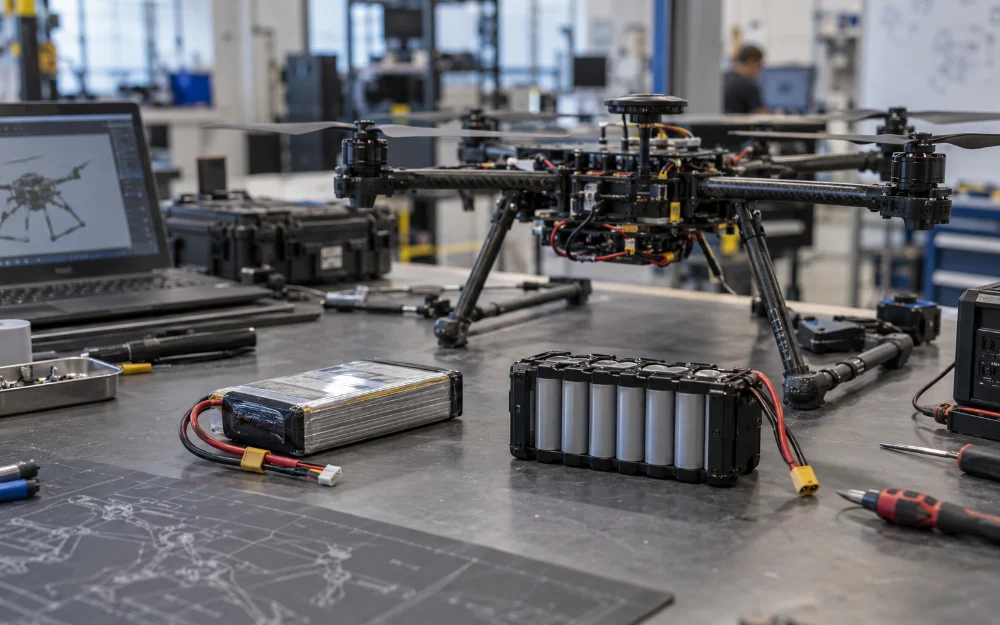
One of the biggest weaknesses in many LiPo-versus-Li-ion comparisons is the assumption that cylindrical Li-ion cells are automatically unsuitable for high-power drones.
That is no longer a reliable rule.
For example, Molicel lists its INR21700-P45B as a 4.5 Ah cylindrical Li-ion power cell with a 45 A discharge-current specification, and explicitly includes drones and eVTOLs among its applications. The manufacturer specification demonstrates how modern cylindrical cells can combine meaningful energy capacity with high-current capability.
That does not mean a P45B—or any other high-power 21700 cell—is automatically the right choice for a particular UAV. It demonstrates something more important:
Battery selection must be made at the individual cell level, not simply from the words “LiPo” or “Li-ion.”
A high-power Li-ion cell may provide enough current for one drone but not another. The answer depends on:
- Required pack voltage
- Continuous aircraft current
- Peak current duration
- Number of parallel cells
- Allowable battery mass
- Thermal conditions
- Available installation space
This is also why C-rate alone can be misleading when comparing different battery formats. Engineers should ultimately convert ratings into actual current capability and compare that against the aircraft’s measured or calculated load.
For a UAV that needs both significant energy and substantial current, modern power-oriented Li-ion cells may deserve evaluation rather than being rejected purely because the platform has traditionally used LiPo.
Chemistry Alone Does Not Define the UAV Battery
Choosing LiPo or Li-ion is only the beginning. The aircraft ultimately flies on a battery pack, not an isolated cell.
The same cell can behave very differently depending on how the pack is constructed.
A custom UAV battery may need to define:
- Series and parallel configuration
- Nominal and maximum voltage
- Target capacity
- Continuous current
- Peak current
- Cable gauge and length
- Connector type
- Protection or BMS strategy
- Temperature monitoring
- Enclosure and insulation
- Maximum dimensions
- Maximum finished-pack weight
These parameters interact.
Suppose a Li-ion cell cannot provide enough current in a single parallel string. Adding another parallel string can increase both capacity and available current. But it also adds cells, weight, physical volume, wiring, and mechanical complexity.
At some point, the theoretical energy advantage may no longer translate into a better aircraft.
The reverse is also true. A high-rate LiPo pack may meet the current requirement easily, but additional pack mass or insufficient usable energy could make it less attractive for an endurance-focused platform.
This is why commercial custom-UAV battery development normally starts with aircraft-level inputs. Battery engineering suppliers commonly request working voltage, target flight time, continuous and peak current, available battery dimensions, maximum weight, connector requirements, and sometimes BMS communication needs before specifying the pack. Custom UAV battery development typically begins with these platform-level parameters.
For an OEM project, the better sequence is therefore:
Mission profile → electrical requirements → cell selection → pack architecture → validation
—not “choose LiPo or Li-ion first and design everything else around that assumption.”
A Practical LiPo vs Li-ion Selection Framework
For an early-stage UAV project, the following framework provides a useful starting point.
Start by Evaluating LiPo When:
- The aircraft has unusually high peak-current demand
- Heavy-load takeoff or rapid acceleration dominates the mission
- High-rate discharge capability is more important than maximum stored energy
- A flexible pouch geometry fits the aircraft efficiently
This does not mean LiPo automatically wins every high-power application. It means high-rate pouch cells deserve early evaluation when power is the main constraint.
Start by Evaluating Li-ion When:
- Flight endurance is a major design target
- Average and peak current remain within the selected cells’ capability
- Cylindrical cells can be packaged efficiently in the airframe
- Additional usable energy provides more mission value than extreme burst output
Long-range drone applications often follow this logic. Specialist long-range FPV experience shows why Li-ion packs can be attractive for efficient cruising while still requiring careful attention to current limits.
Evaluate Both Architectures When:
- The aircraft needs both strong takeoff power and long endurance
- Payload varies substantially between missions
- Takeoff current is much higher than cruise current
- The design is close to its weight or space limit
- Standard off-the-shelf packs do not fit the required performance envelope
Before making the decision, define at least:
Pack voltage · Continuous current · Peak current · Target flight time · Payload · Battery bay dimensions · Maximum battery weight
If those values are still unknown, selecting a battery chemistry is premature.
Final Takeaway
LiPo is usually the more natural starting point for UAVs dominated by high peak-current demands, while Li-ion often deserves priority when usable energy and endurance matter more. But modern high-power cylindrical cells have made that boundary less clear.
The final decision should therefore be based on the specific cell and the complete battery-pack architecture, not a generic LiPo-versus-Li-ion rule.
For an engineered UAV battery, the most important question is not simply “Which chemistry is better?” It is which battery architecture can meet the aircraft’s power, energy, weight, space, and mission requirements with sufficient margin.
Frequently Asked Questions
Can Li-ion Batteries Provide Enough Current for a Drone?
Yes, some can. Modern high-power 18650 and 21700 cells can deliver substantial current, but the required continuous and peak current must be checked against the specific cell and finished pack configuration. A Li-ion label alone does not tell you whether the battery can support the aircraft.
Is LiPo Safer Than Li-ion for UAV Applications?
Neither format is automatically safe simply because of its label. Cell quality, charging control, pack construction, thermal conditions, mechanical protection, and operating limits all affect battery safety. Pouch cells also require appropriate allowance for mechanical protection and possible swelling.
Does Switching from LiPo to Li-ion Automatically Increase Flight Time?
No. Higher usable energy can help, but the pack must still meet the aircraft’s current demand without adding excessive weight. Propulsion efficiency, payload, flight profile, and the final pack architecture determine whether the theoretical energy advantage becomes real flight time.
What Information Is Needed to Design a Custom UAV Battery?
A battery engineer will typically need the UAV’s required voltage, continuous and peak current, target flight time, payload, available battery space, maximum battery weight, connector requirements, and operating conditions. These inputs allow the cell and pack configuration to be evaluated as one system.