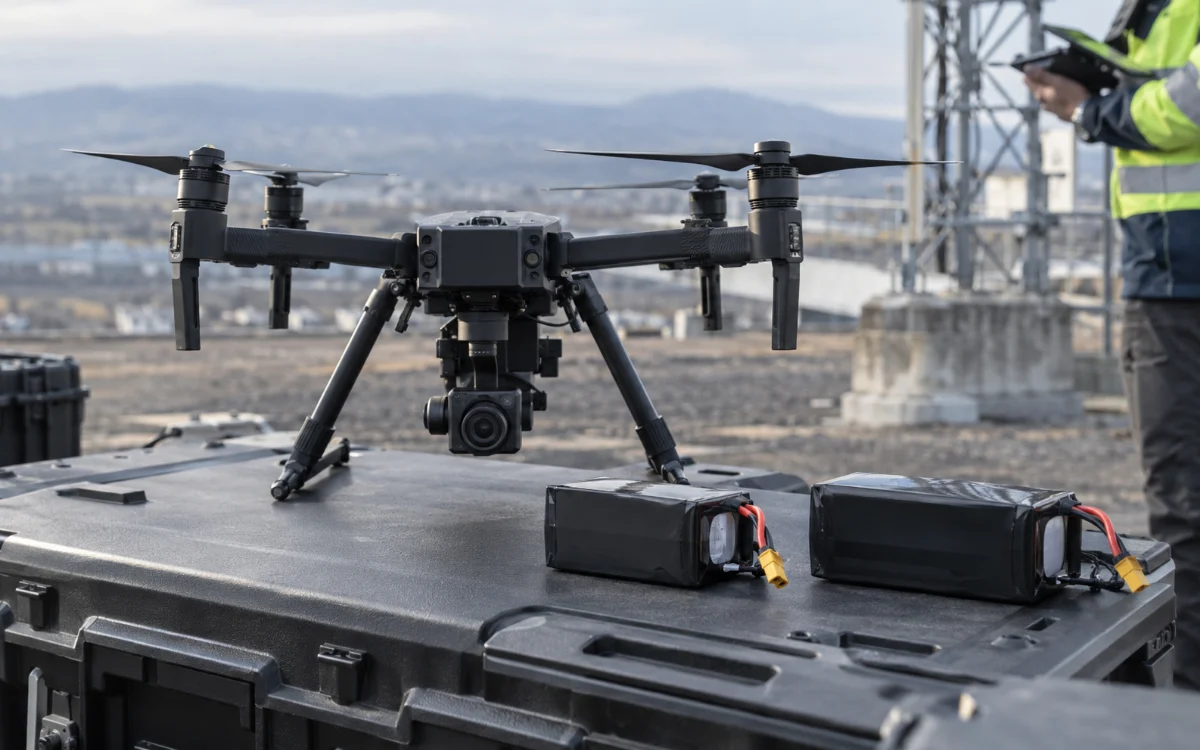
Neither 18650 nor 21700 is automatically the better choice for a drone or UAV battery pack. A 21700 cell usually stores more energy per cell and can reduce the number of cells needed in some pack architectures. An 18650 cell is smaller and may fit constrained airframes more efficiently or provide a better result when a suitable high-power cell already meets the aircraft’s requirements.
The useful comparison is therefore not one 18650 cell against one 21700 cell. UAV designers should compare complete pack configurations at the same voltage, usable energy, continuous and peak current, weight limit, and available installation space. The better format is the one that produces the better finished battery for the aircraft.
18650 vs 21700: What Changes at Pack Level?
The most obvious difference is physical size. NASA describes the 18650 format as approximately 18 × 65 mm and the 21700 as approximately 21 × 70 mm, while noting that 21700 cells can offer mechanical packaging benefits through fewer cells in some applications. The larger format gives manufacturers more internal volume for active material, so a 21700 cell can usually store more energy than a comparable 18650 cell.
| Design Factor | 18650 | 21700 |
|---|---|---|
| Cell diameter | Smaller | Larger |
| Energy per cell | Typically lower | Typically higher |
| Individual cell weight | Typically lower | Typically higher |
| Cell count for a target energy | May require more cells | Can require fewer cells |
| Packaging flexibility | Useful in tighter layouts | Useful when larger cells fit efficiently |
| High-power cell options | Available | Available |
More energy per cell should not be confused with higher energy density in every case. A controlled study published in the Journal of Power Sources built 18650 and 21700 cells using the same electrodes, separator, and electrolyte. The researchers measured roughly 50% more capacity and energy per 21700 cell under the tested conditions, but also observed differences in thermal behavior. In commercial cells, chemistry, electrode design, internal resistance, and intended power level can all change the result.
For a UAV project, the relevant values are therefore not simply cell diameter and mAh. The decision should be based on what happens after those cells are assembled into the required series-parallel architecture. This same pack-level approach is important when evaluating battery cell selection and integration for a custom battery system.
More Energy per Cell Can Reduce Pack Cell Count
The main advantage of 21700 in many endurance-focused UAV designs is that more energy per cell can reduce the number of parallel cells required to reach a target capacity. That can change the entire pack architecture.
A U.S. Army Research Laboratory review of cylindrical batteries for UAS applications illustrates this clearly. Its comparison included a 6S2P LG M36 18650 pack using 12 cells at 6.9Ah and 582g, compared with a 6S1P LG M50 21700 pack using six cells at 5.0Ah and 415g. The same report also listed a 6S2P 21700 configuration using 12 cells at 10.0Ah and 830g.
Those examples do not prove that 21700 packs are lighter. They demonstrate something more useful: cell format alone does not determine pack weight. The required capacity and parallel count can change the outcome dramatically.
If a UAV needs modest continuous current and its energy target can be achieved with a 21700 1P configuration, the design may use substantially fewer cells than an 18650 pack requiring two cells in parallel. Fewer cells can also mean fewer cell-to-cell connections and a simpler mechanical layout.
But the advantage can disappear when both formats require the same number of parallel groups. A 21700 cell is individually larger and heavier, so simply replacing 18650 cells with 21700 cells without recalculating the complete architecture may increase pack mass without producing enough additional usable energy to justify it.
The practical question is not, “Which cell has more capacity?” It is:
How many 18650 or 21700 cells are required to meet the same voltage, energy, and current requirement?
Discharge Current Can Change the Choice
A battery with enough stored energy is still unsuitable if it cannot support the UAV’s electrical load. Takeoff, climb, acceleration, maneuvering, and payload operation can push current above the aircraft’s normal cruise demand, so cell selection has to consider both continuous and peak loads.
The assumption that 18650 is inherently a low-power format while 21700 is a high-power format is incorrect. For example, Molicel’s INR-18650-P30B has a typical capacity of 3.0Ah and a listed discharge current of 36A, and the manufacturer includes drones and eVTOLs among its applications. Molicel’s larger INR-21700-P45B provides 4.5Ah capacity with a listed 45A discharge current.
These specifications are examples of two particular power cells, not general ratings for their formats. They show why engineers should select the actual cell model before drawing conclusions about 18650 versus 21700.
C-rate can also be misleading when compared without capacity. Battery University explains that 1C corresponds to a discharge current equal to the battery’s rated amp-hour capacity. A 3Ah cell at 10C represents 30A, while a 5Ah cell at 10C represents 50A.
For UAV selection, a more useful sequence is:
continuous aircraft current → peak current → cell current capability → required parallel count → finished pack weight and dimensions
This approach prevents a high-capacity cell with insufficient power capability from being selected only because its mAh number looks attractive.
More Capacity Does Not Automatically Mean More Flight Time
A larger battery can carry more energy, but the aircraft must also carry the additional battery mass. That is why a higher-capacity 21700 pack does not translate into a proportional increase in flight time.
The U.S. Army Research Laboratory’s UAS analysis treats battery capacity together with pack weight, dimensions, voltage, and continuous rate capability. That is a better framework for UAV selection than comparing rated capacity alone.
A practical finished-pack comparison shows the same tradeoff. In a 2025 test of two 6S Li-ion drone batteries, the 18650-based pack was rated at 3000mAh and weighed 314g, while the 21700-based pack provided 4500mAh at 428.7g. The larger pack provided substantially more stored energy and higher rated current, but it also added more than 100g to the aircraft.
That does not tell every UAV designer which pack to choose. A larger mapping or long-endurance platform may make productive use of the additional energy, while a smaller aircraft may lose too much efficiency or payload margin as battery mass increases.
For this reason, compare watt-hours rather than mAh when stored energy is the objective, and then compare those watt-hours against finished-pack weight. The final endurance benefit still depends on the aircraft’s propulsion efficiency, payload, operating profile, and power consumption.
How to Choose Between 18650 and 21700 for a UAV
The most reliable method is to define the aircraft requirements first, then build candidate 18650 and 21700 pack configurations against the same targets.
18650 Is Often the Better Fit When…
The installation space is tightly constrained. The smaller cell diameter can provide more flexibility in narrow battery compartments or around existing structural components.
The aircraft already uses an established 18650 architecture. Moving to 21700 can require changes to the enclosure, holders, mounting arrangement, wiring, and weight distribution. Extra cell capacity may not justify that redesign.
A suitable 18650 already meets the required current. Modern high-power 18650 cells can support demanding loads, so changing format solely to obtain more discharge capability may be unnecessary.
The energy target does not require excessive parallel groups. If an 18650 configuration already reaches the required Wh within the weight and volume limits, a larger cell may provide little system-level benefit.
21700 Is Often the Better Fit When…
Endurance is a primary design objective. Higher energy per cell can help when the aircraft needs more stored energy without increasing cell count as quickly.
The larger capacity reduces total cell count. This is especially useful when moving to 21700 eliminates a parallel group while still satisfying the required current.
The airframe can accommodate the larger diameter efficiently. A theoretical energy advantage has limited value if the resulting battery creates a poor mechanical fit.
The selected 21700 cell satisfies both energy and power requirements. Capacity, continuous current, peak-load behavior, and pack weight need to work together.
Before selecting either format, define:
- required pack voltage;
- target usable energy in Wh;
- continuous operating current;
- peak current and its duration;
- maximum allowable battery weight;
- available installation volume;
- candidate cell specifications;
- required series-parallel configuration.
Then calculate the total cell count, pack weight, dimensions, and current margin for each option. Lithogenix applies the same system-level principle when developing lithium-ion battery packs: the cell is one part of a pack that must also fit the electrical, mechanical, and operating requirements of the application.
Final Takeaway
21700 is often a strong starting point for an endurance-focused UAV because more energy per cell can reduce cell count and simplify some pack architectures. It is not automatically the better drone battery. An 18650 configuration may produce a better result when space is constrained, an existing airframe is already designed around the smaller format, or a suitable 18650 cell meets the power requirement with less overall battery mass.
The correct comparison is two finished battery designs built around the same voltage, usable Wh, current demand, weight limit, and available space. Choose the pack that fits the aircraft, not simply the larger cell.
FAQ
Does a 21700 cell always have higher energy density than an 18650?
No. A 21700 cell normally stores more energy per cell because it is physically larger, but gravimetric energy density in Wh/kg depends on the specific chemistry and cell design. Compare actual cell specifications instead of assuming that format alone determines energy density.
Can a high-power drone use 18650 cells?
Yes. High-discharge 18650 cells are available, and some are designed for demanding drone applications. Suitability depends on whether the selected cell and pack configuration can support the aircraft’s continuous and peak current without creating an unacceptable weight or voltage-drop penalty.
Should UAV batteries be compared by mAh or Wh?
Use Wh when comparing stored energy, particularly when pack voltages differ. For an actual UAV, Wh should still be evaluated together with battery weight, dimensions, and current capability rather than used as a standalone selection metric.
Does using fewer cells always produce a better UAV battery pack?
No. Fewer cells can simplify the pack architecture, but a larger cell may also increase individual-cell mass or create packaging constraints. The better design is the one that meets the aircraft’s energy and power requirements within its weight and space limits.