
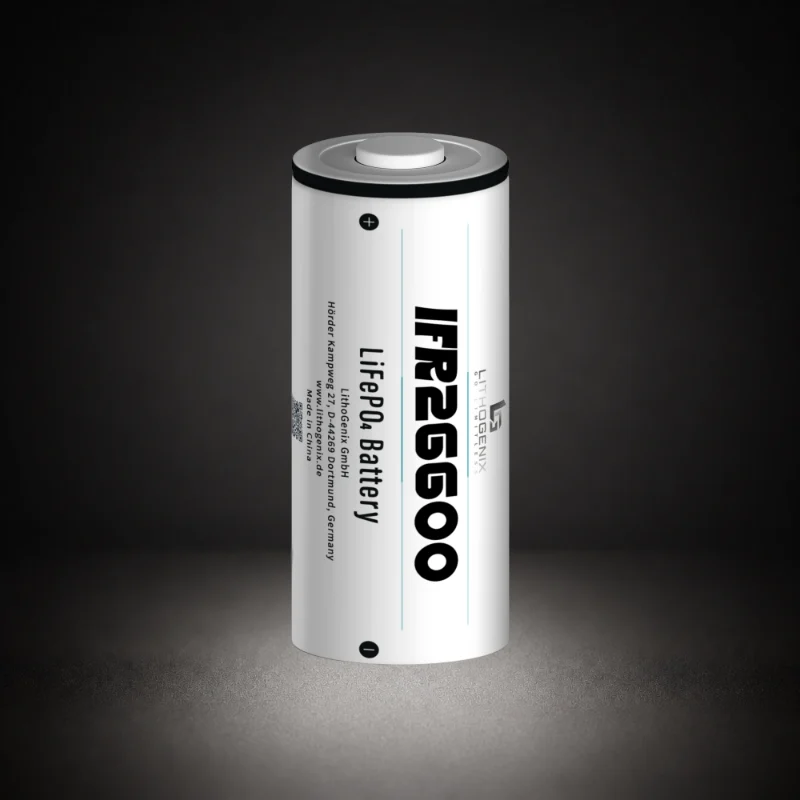
The IFR32800 LiFePO₄ Cylindrical Cell is designed for rechargeable battery systems where higher cell-level energy, stable output, and long service life are key priorities. Its larger cylindrical format provides an efficient building block for battery packs used in energy storage, electric mobility, backup power, and other applications that require substantial usable energy.
Compared with smaller cylindrical formats, the IFR32800 allows battery designers to place more energy into each cell position while maintaining the mechanical consistency and modular configuration advantages of a cylindrical architecture.
More Energy in a Cylindrical Format
The IFR32800 is particularly useful when battery pack capacity needs to increase without relying on a large number of smaller cells.
Higher energy per cell can help designers optimize:
- total cell count
- parallel configuration
- interconnection complexity
- available pack volume
- assembly requirements
- overall battery architecture
The final configuration should still be determined according to system voltage, runtime target, continuous current, peak load, and available installation space.
Stable Performance for Repeated Use
LiFePO₄ chemistry provides a stable voltage platform and is widely used in rechargeable systems where predictable operation and long-term cycling are important.
For applications that operate or recharge frequently, the IFR32800 can support battery designs focused on:
- consistent energy delivery
- repeatable charge and discharge cycles
- stable thermal behavior
- long service intervals
- reduced replacement frequency
Actual battery life will depend on depth of discharge, charge strategy, operating temperature, current profile, and BMS settings.
Energy Storage Systems
The higher-capacity cylindrical format makes the IFR32800 well suited to stationary systems where stored energy and long-term cycling are major design considerations. Commercial 32800 cells are commonly positioned for stationary and industrial energy-storage applications.
Typical applications may include:
- commercial energy storage
- industrial energy storage
- renewable energy storage
- distributed battery systems
- solar energy systems
- small and medium stationary storage
Pack configuration can be adapted according to required system voltage, usable capacity, charging source, and expected operating cycle.
Electric Mobility
The IFR32800 can also serve as an energy-focused cell platform for electric mobility systems where usable capacity and operating range are important.
Potential applications include:
- electric two-wheelers
- electric three-wheelers
- low-speed electric vehicles
- electric utility vehicles
- mobility equipment
- auxiliary traction battery systems
Electric two-/three-wheelers and related EV applications are also documented use cases for commercially available 32800 LiFePO₄ cells.
For traction applications, pack design should account for motor load, acceleration current, expected range, thermal conditions, and charging requirements.
UPS & Backup Power
Backup systems benefit from cells that can remain ready for use while providing dependable energy when primary power is interrupted.
The IFR32800 can be integrated into battery packs for:
- UPS systems
- emergency power supplies
- industrial control backup
- security systems
- communication equipment
- critical electronic systems
Commercial 32800 specifications also identify UPS and backup applications as typical use cases.
Battery capacity should be determined according to standby load, required backup duration, discharge current, and installation environment.
Communication & Remote Systems
Communication infrastructure and remotely installed equipment may require batteries that can remain in service for extended periods while delivering dependable backup energy.
Potential applications include:
- telecom backup systems
- communication base equipment
- remote monitoring stations
- distributed control systems
- network infrastructure
- field communication equipment
Commercial 32800 cells are specifically marketed for communication backup power, supporting this application direction.
Portable & Auxiliary Power Systems
The IFR32800 can also be integrated into portable or auxiliary power systems where a relatively high amount of energy is required within a modular cylindrical-cell architecture.
Potential applications include:
- portable power systems
- outdoor power equipment
- auxiliary battery modules
- mobile industrial power
- field equipment
- rechargeable power platforms
The final pack design can be adjusted according to runtime, enclosure volume, output current, charging interface, and environmental requirements.
Where IFR32800 Fits Best
The IFR32800 is particularly suitable when a battery system prioritizes:
- higher stored energy per cylindrical cell
- long cycle-life potential
- stable rechargeable performance
- reduced dependence on large numbers of smaller cells
- flexible series-parallel configuration
- modular pack construction
- energy-focused battery architecture
It is therefore a strong fit for energy storage, electric mobility, UPS and backup power, communication systems, and other applications where usable energy and long-term operation are primary battery design priorities.