
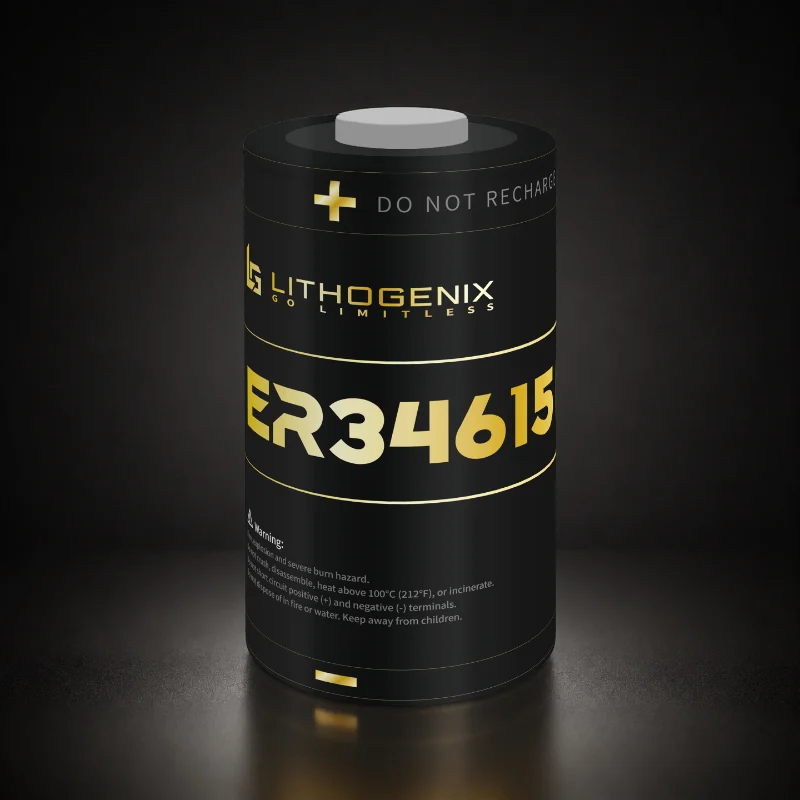
The ER34615 Li-SOCl₂ battery is the largest-capacity model in this Lithogenix ER cylindrical range. With 19,000 mAh nominal capacity in a 33.1 × 61.5 mm body, it is intended for applications where maximizing available energy and extending maintenance intervals take priority over minimizing battery volume.
This makes ER34615 especially relevant to equipment deployed offshore, underground, across remote infrastructure, or in geographically dispersed monitoring networks where every battery replacement can require significant labor, travel, or system downtime.
When Maintenance Access Drives Battery Choice
Some battery-powered devices are easy to service. Others may remain attached to pipelines, installed at remote monitoring stations, deployed offshore, or positioned in locations that are rarely visited.
For these applications, battery selection is not simply a question of fitting enough capacity into the enclosure. The energy reserve must be considered against the planned deployment period and the practical cost of maintenance.
ER34615 provides a substantial 19 Ah nominal capacity, allowing OEM designers to allocate a larger lifetime energy budget to sensing, data processing, logging, telemetry, and other periodic functions.
A Large Energy Reserve for Long-Term Deployment
The high capacity of ER34615 is particularly valuable in systems that consume small amounts of power continuously over several years.
Instead of aggressively minimizing every individual measurement or reporting event, designers have more available energy for functions such as:
- scheduled sensor readings
- onboard data storage
- periodic system diagnostics
- GPS positioning
- environmental measurement
- telemetry and status reporting
Actual service life still depends on the complete load profile, temperature history, self-discharge behavior, cutoff voltage, and frequency of active events.
Current Capability for Larger Field Systems
ER34615 supports a maximum continuous current of 230 mA and a maximum pulse current of 300 mA, providing more electrical headroom than smaller cells in the ER series.
This makes it better suited to equipment with more active electronics or longer operating intervals between sleep states.
However, many modern cellular, NB-IoT, satellite, or high-power radio transmitters can generate short current peaks well above the cell’s standalone pulse capability. Where this occurs, a battery capacitor or other pulse-support architecture may be required.
The battery should therefore be evaluated using the actual current waveform rather than nominal device power alone.
Typical Applications
Marine & Ocean Monitoring
Well suited to selected oceanographic buoys, marine monitoring stations, offshore sensors, and long-duration environmental instruments where battery replacement at sea is difficult.
Seismic & Geophysical Equipment
Applicable to seismic nodes, remote survey instruments, and geophysical monitoring equipment that may remain deployed in the field for extended measurement campaigns.
Pipeline & Energy Infrastructure
A practical option for pipeline monitoring, corrosion monitoring, leak detection, and distributed energy-infrastructure sensors installed across large geographic areas.
Remote Monitoring Stations
Can support weather stations, environmental monitoring systems, telemetry terminals, and unattended data acquisition equipment operating far from regular maintenance access.
Asset & Infrastructure Tracking
Suitable for selected long-duration tracking and monitoring systems where a larger enclosure can accommodate the cell and extended operating life is a primary design requirement.
Industrial IoT & Telemetry
ER34615 can also serve industrial IoT gateways, remote sensor nodes, and telemetry equipment with larger lifetime energy budgets and repeated measurement cycles.
Environmental Deployment Considerations
ER34615 is specified for operation across −55°C to +85°C, supporting deployment in a wide range of outdoor and industrial environments.
This characteristic is useful for equipment exposed to seasonal temperature swings, cold outdoor conditions, remote infrastructure, or industrial installations where climate control is unavailable.
For specialized applications such as high-temperature downhole oil and gas equipment, a dedicated high-temperature Li-SOCl₂ cell should be selected instead of assuming a standard ER34615 is suitable.