
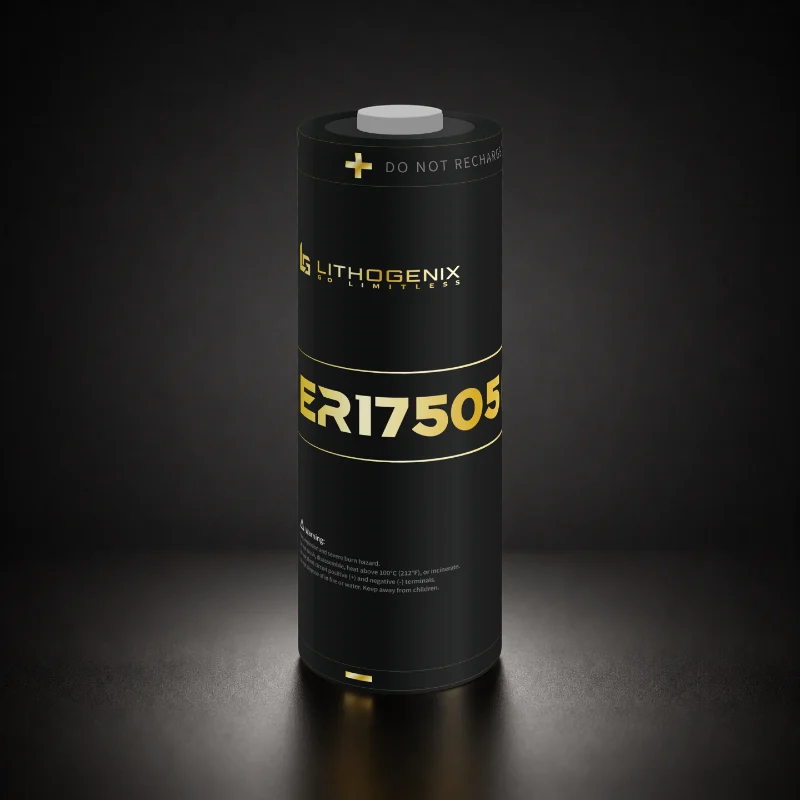
The ER17505 Li-SOCl₂ battery is designed for applications that place greater electrical demand on the cell while still requiring multi-year unattended operation.
With 3600 mAh nominal capacity, a maximum continuous current of 100 mA, and a maximum pulse current of 180 mA, ER17505 provides a larger energy reserve and stronger load capability than smaller cylindrical Li-SOCl₂ cells. This makes it particularly relevant to industrial electronics that perform more frequent sensing, processing, logging, or communication throughout their service life.
More Energy for Active Remote Electronics
Long-life equipment does not always mean ultra-low-power equipment.
Remote monitoring nodes, telemetry units, industrial sensors, and connected meters may wake frequently to collect measurements, process data, and transmit information. These operating cycles gradually increase total energy consumption even when the device remains in standby between events.
The 3600 mAh capacity of ER17505 provides additional energy headroom for these more active duty cycles while maintaining the long-term characteristics expected from Li-SOCl₂ chemistry.
Greater Continuous Current Capability
One of the key differences between ER17505 and smaller ER cells is its ability to support a higher continuous electrical load.
With a specified maximum continuous current of 100 mA, ER17505 can be considered for devices whose baseline or active operating current exceeds the practical range of smaller half-AA or AA-size cells.
Its 180 mA maximum pulse current also provides additional margin for intermittent functions such as wireless transmission, sensor activation, data acquisition, and control electronics.
For communication-intensive devices, however, actual peak current, pulse duration, and recovery interval should still be reviewed before final battery selection.
Typical Applications
Industrial Remote Monitoring
Suitable for field sensors, equipment monitoring nodes, infrastructure monitoring systems, and other installations expected to operate for extended periods with limited maintenance access.
Smart Metering & Utility Equipment
Applicable to smart water meters, gas meters, heat meters, industrial meters, and communication-enabled utility devices with higher energy consumption or more frequent data transmission.
Wireless Telemetry Systems
A practical power source for telemetry terminals, LoRa-based monitoring devices, remote data acquisition equipment, and distributed sensing systems.
Asset & Equipment Tracking
Can support long-term tracking devices for industrial assets, logistics equipment, containers, and machinery where sensing and communication occur repeatedly throughout deployment.
Pipeline & Infrastructure Monitoring
Well suited to selected pipeline sensors, utility infrastructure nodes, corrosion monitoring equipment, and other remote installations where reliable long-term energy availability is important.
Environmental Monitoring
Applicable to weather stations, environmental sensors, data loggers, and field measurement equipment exposed to seasonal temperature changes and long service intervals.
Built for Demanding Field Environments
ER17505 combines the high energy density of lithium thionyl chloride chemistry with an operating temperature range of −55°C to +85°C.
This allows the cell to be considered for installations exposed to outdoor, industrial, refrigerated, or remote environmental conditions where conventional battery replacement may be difficult.
The complete system should still be evaluated according to enclosure design, terminal configuration, thermal conditions, load profile, and expected deployment period.