
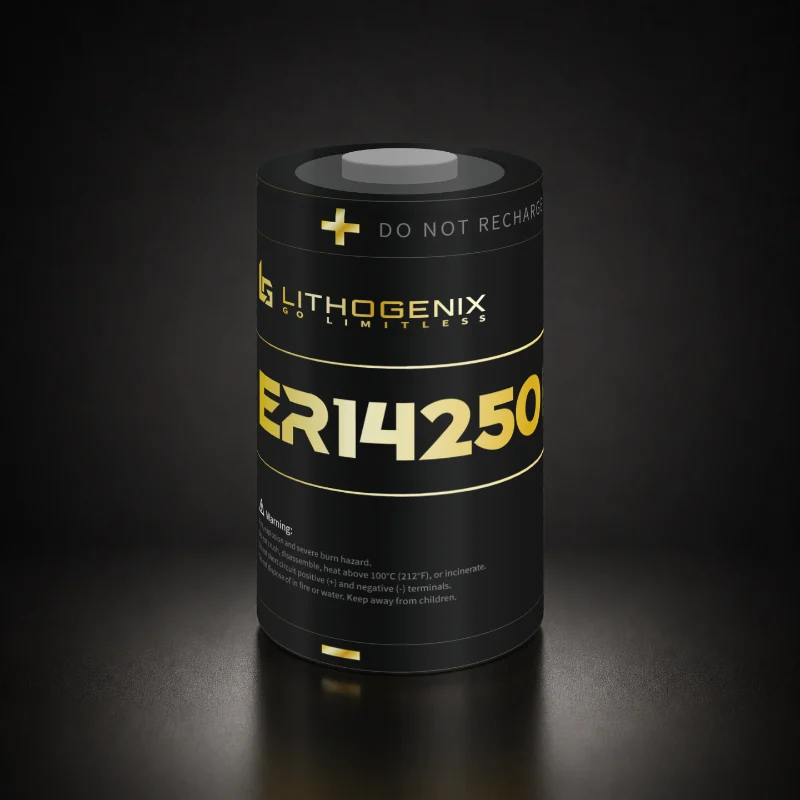
The ER14250 Li-SOCl₂ battery is one of the most compact cylindrical cells in the Lithogenix lithium thionyl chloride range. With a nominal capacity of 1200 mAh in a 14.5 × 25.4 mm body, it is intended for devices that consume very little power over long periods and cannot accommodate a larger battery.
Its 3.6V nominal voltage, high energy density, low long-term energy loss, and wide operating temperature range make ER14250 particularly relevant to electronics expected to remain installed for extended periods with limited access for battery replacement.
Compact Energy for Low-Power Devices
ER14250 is best matched to applications where minimizing battery volume is more important than maximizing total capacity.
Its half-AA cylindrical format allows designers to integrate primary lithium power into compact meters, sensors, monitoring nodes, and embedded electronics without allocating the space required by larger ER cells.
With a maximum continuous current of 35 mA, the cell is particularly suitable for equipment that spends most of its operating life in sleep, standby, sensing, or low-current measurement modes.
Designed for Long-Term Field Operation
Many ER14250 applications are expected to operate unattended for months or years.
A high nominal voltage of 3.6V, combined with the energy characteristics of Li-SOCl₂ chemistry, supports long-duration power requirements in equipment such as utility meters, environmental sensors, and remote monitoring devices.
The cell is rated for operation across −55°C to +85°C, making it suitable for equipment installed in outdoor, industrial, refrigerated, or otherwise temperature-variable environments when the complete device is designed for those conditions.
Typical Applications
Utility & Smart Metering
Suitable for compact water meters, gas meters, heat meters, meter memory circuits, and low-power metering electronics requiring long service intervals.
IoT & Remote Sensors
A practical power source for low-duty-cycle IoT nodes, environmental sensors, data loggers, and remote monitoring devices that remain asleep or in standby for most of their service life.
Asset & Animal Monitoring
Can be used in compact tracking and monitoring devices where positioning, sensing, or communication events occur at controlled intervals and average power consumption remains low.
Cold-Chain Monitoring
The wide operating temperature capability makes ER14250 relevant to selected temperature and humidity data loggers used in refrigerated storage, transport, and cold-chain monitoring.
Marine & Remote Monitoring Electronics
Suitable for selected compact monitoring instruments, telemetry nodes, and remote sensors where access for routine battery replacement is difficult.
Compact Medical Electronics
ER14250 may also be considered for selected low-power medical monitoring or portable devices where the battery requirements, qualification process, and electrical load are compatible with the cell.
Pulse Load Considerations
ER14250 provides a specified maximum pulse current of 50 mA, so the actual communication profile should be reviewed carefully before using it in wireless equipment.
Some NB-IoT, cellular, GPS, or other radio modules can require current peaks above the capability of a standalone ER14250 cell. In these cases, a pulse-support component such as a battery capacitor may be required, or a larger Li-SOCl₂ cell with greater discharge capability may be more appropriate.
Battery selection should therefore consider peak current, pulse duration, transmission interval, and recovery time, rather than relying on capacity alone.