
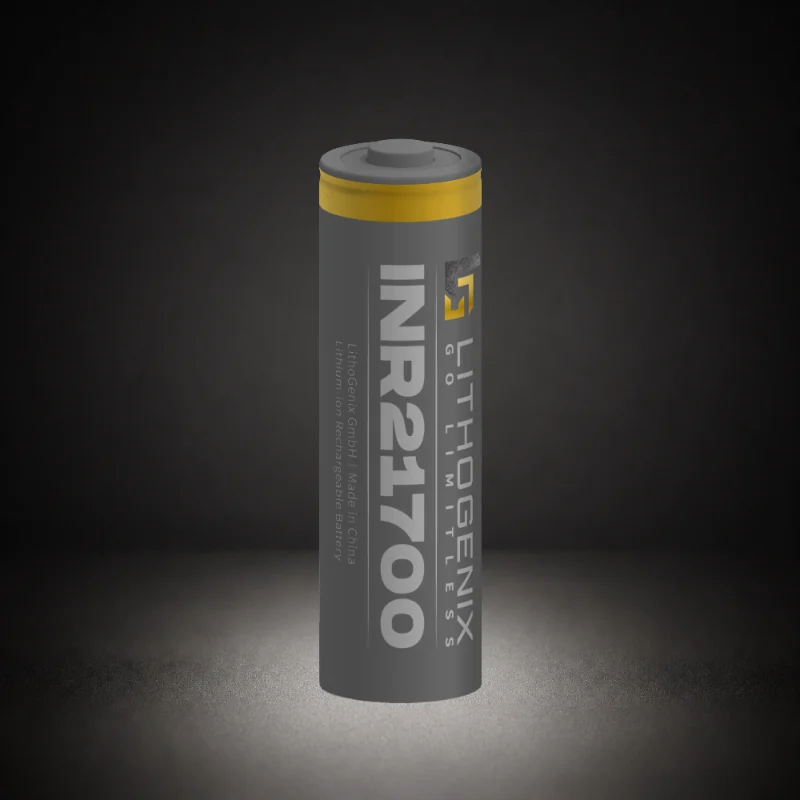
5000mAh Capacity for Energy-Dense Battery Packs
The 21700-50E delivers 5000mAh capacity in the standard 21700 cylindrical format, providing substantially more stored energy per cell than lower-capacity power-oriented alternatives.
Its high capacity makes it particularly useful for battery systems where runtime, driving range, or operating duration is a higher priority than extreme discharge current. Designers can use the additional cell-level energy to reach a target pack capacity with fewer parallel cells, depending on the voltage and current requirements of the application.
257Wh/kg Energy Density for Space-Constrained Designs
With an energy density of approximately 257Wh/kg, the 21700-50E is positioned toward energy-focused battery applications.
Key specifications include:
- Capacity: 5000mAh
- Nominal Voltage: 3.65V
- Working Voltage: 2.5–4.2V
- Maximum Charge Current: 10A
- Maximum Discharge Current: 15A
- Energy Density: Approx. 257Wh/kg
- Standard Cycle Life at 25°C: 1000 cycles
- Maximum Weight: 71g
- Dimensions: Approx. 21.15 × 70.15mm
This specification profile makes the 50E a better match for applications requiring more stored energy and sustained runtime rather than the very high current output targeted by dedicated power cells.
Fewer Cells for a Given Pack Energy
Higher capacity at the individual cell level can simplify battery pack architecture. For a given energy target, the 5000mAh 21700-50E may reduce the number of cells and parallel connections required compared with lower-capacity cylindrical cells.
Depending on the pack design, this can contribute to:
- Fewer cell interconnections
- Reduced welding points
- More efficient use of pack volume
- Simplified mechanical layout
- Higher energy capacity within a given enclosure
The final pack configuration should still be determined according to voltage, continuous current, peak current, thermal conditions, and required redundancy.
Designed for Longer Service and Frequent Recharge Cycles
Supplier specifications list a standard cycle life of 1000 cycles at 25°C, making the 21700-50E particularly relevant to rechargeable equipment that is expected to remain in regular service over an extended period.
Actual cycle life in a finished battery pack will depend on charge voltage, depth of discharge, current profile, operating temperature, thermal management, and BMS strategy.
For applications such as mobility systems and service robots, these factors should be evaluated alongside nominal capacity when establishing the expected battery service life.
Typical Applications
The 21700-50E is well suited to applications where high capacity and longer operating time are key design priorities, including:
- E-bike battery packs
- Electric scooter replacement batteries
- Portable power station battery packs
- High-capacity 21700 power banks
- Outdoor and camping battery systems
- Commercial cleaning robots
- Service robot battery packs
- AI companion robots
- Other long-runtime rechargeable equipment
For devices requiring continuous 30–40A high-power output from an individual cell, a power-focused model such as the 21700-30P would generally be more appropriate.
Battery Pack Integration Around Runtime Requirements
Lithogenix can integrate the 21700-50E into customized lithium-ion battery packs according to required pack voltage, total energy, runtime, discharge current, physical dimensions, connector configuration, and protection requirements.
Battery pack development can include series-parallel configuration, BMS selection, cell interconnection, wiring, enclosure design, thermal considerations, and pack-level testing, allowing the high-capacity characteristics of the 21700-50E to be matched to mobility, portable energy, and robotic equipment.