
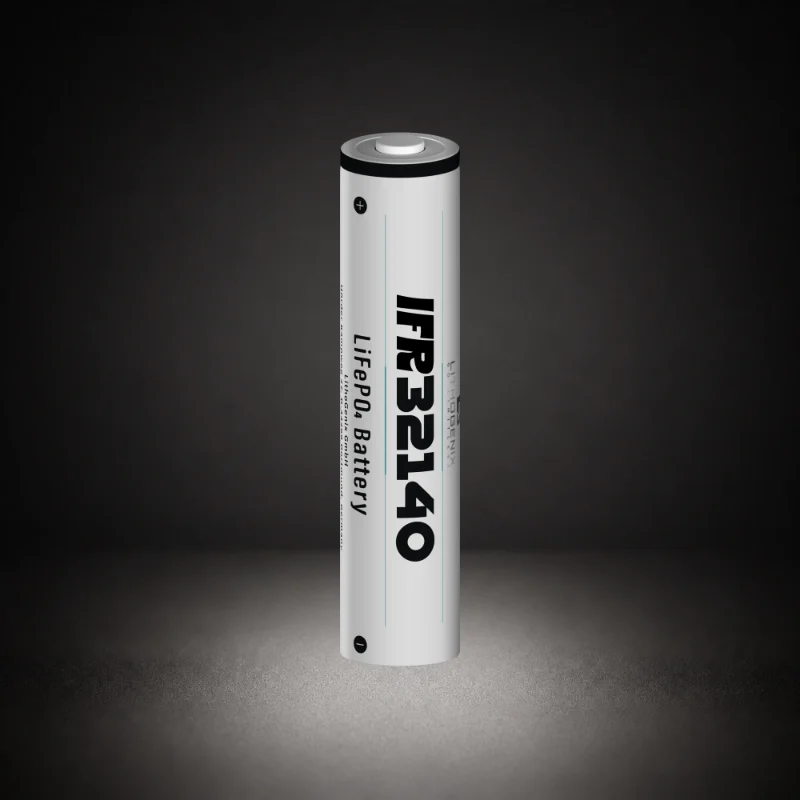
The IFR32140 LiFePO₄ Cylindrical Cell is designed for rechargeable battery systems that require higher cell-level capacity, long service life, and stable power delivery within a cylindrical architecture. Its larger format makes it particularly suitable for energy storage, electric mobility, material-handling equipment, and industrial battery systems where reducing cell count can simplify pack construction.
By storing more energy in each individual cell than smaller cylindrical formats, the IFR32140 can help designers build higher-capacity battery packs with fewer parallel cells, while retaining the cycle-life, thermal stability, and safety characteristics associated with LiFePO₄ chemistry.
Higher Capacity with Fewer Cells
The larger 32140 format is well suited to battery systems where substantial pack capacity must be achieved without relying on a large number of smaller cylindrical cells.
Using higher-capacity cells can help reduce:
- the number of parallel cells
- welded interconnections
- cell holders and supporting components
- pack assembly complexity
- space required for electrical connections
This can be especially valuable in larger battery systems where cell count, assembly efficiency, and pack architecture all affect final system design.
Stable Power for Larger Battery Systems
The IFR32140 is intended for systems that require predictable power delivery over repeated operating cycles.
Its cylindrical construction can support consistent mechanical integration while giving battery designers flexibility in series-parallel configuration. When matched with an appropriate BMS, conductor design, and thermal strategy, the cell can be incorporated into battery packs requiring both substantial stored energy and dependable current delivery.
Key pack-level considerations include:
- continuous operating current
- peak load requirements
- busbar and interconnection design
- cell temperature distribution
- pack cooling
- BMS protection settings
Designed for Long-Term Cycling
LiFePO₄ chemistry is particularly well suited to applications where the battery is charged and discharged frequently over an extended service period.
For larger battery systems, long cycle life can directly influence:
- maintenance intervals
- replacement frequency
- total lifecycle cost
- system availability
- long-term capacity retention
Actual battery life will depend on depth of discharge, charge strategy, temperature, current profile, and the design of the finished battery pack.
Energy Storage Systems
The IFR32140 is well suited to stationary battery packs where higher capacity per cell can help simplify the overall system architecture.
Typical applications may include:
- distributed energy storage
- commercial energy storage
- renewable energy storage
- industrial battery systems
- smart energy systems
- small and medium stationary storage systems
For these applications, series and parallel configuration can be selected according to required system voltage, usable capacity, backup duration, and installation space.
Low-Speed Electric Mobility
The larger cylindrical format also makes the IFR32140 relevant to electric mobility systems that require more energy per cell while maintaining a modular battery-pack design.
Potential applications include:
- low-speed electric vehicles
- electric scooters
- electric utility vehicles
- electric logistics vehicles
- light commercial mobility
- specialized electric transport equipment
For traction applications, the finished pack should be designed around motor power, acceleration current, driving range, thermal conditions, and charging requirements.
AGVs & Material-Handling Equipment
Automated guided vehicles and other material-handling systems typically operate through repeated charge and discharge cycles and may remain in service for long working periods.
The IFR32140 can be incorporated into battery systems for:
- AGVs
- electric forklifts
- warehouse transport vehicles
- autonomous material-handling equipment
- logistics robots
- industrial mobile platforms
Higher cell-level capacity can be particularly useful where designers want to achieve the required pack energy with fewer individual cells.
UPS & Industrial Backup Power
The IFR32140 can also be considered for backup systems where dependable energy availability and long service life are more important than minimizing battery size.
Typical applications may include:
- industrial UPS systems
- control-system backup
- communication equipment
- emergency power modules
- automation systems
- critical electronic equipment
Pack capacity should be configured according to required backup duration, standby load, discharge profile, and available installation space.
Where IFR32140 Fits Best
The IFR32140 is particularly suitable when a battery system prioritizes:
- higher capacity per cylindrical cell
- reduced cell count
- simplified pack architecture
- long cycle-life potential
- stable rechargeable power
- flexible series-parallel configuration
- reliable operation in larger battery systems
It is therefore a strong fit for energy storage, electric mobility, AGVs, material-handling equipment, industrial backup power, and other applications where higher cell-level capacity and long-term system performance are more important than minimizing individual cell size.