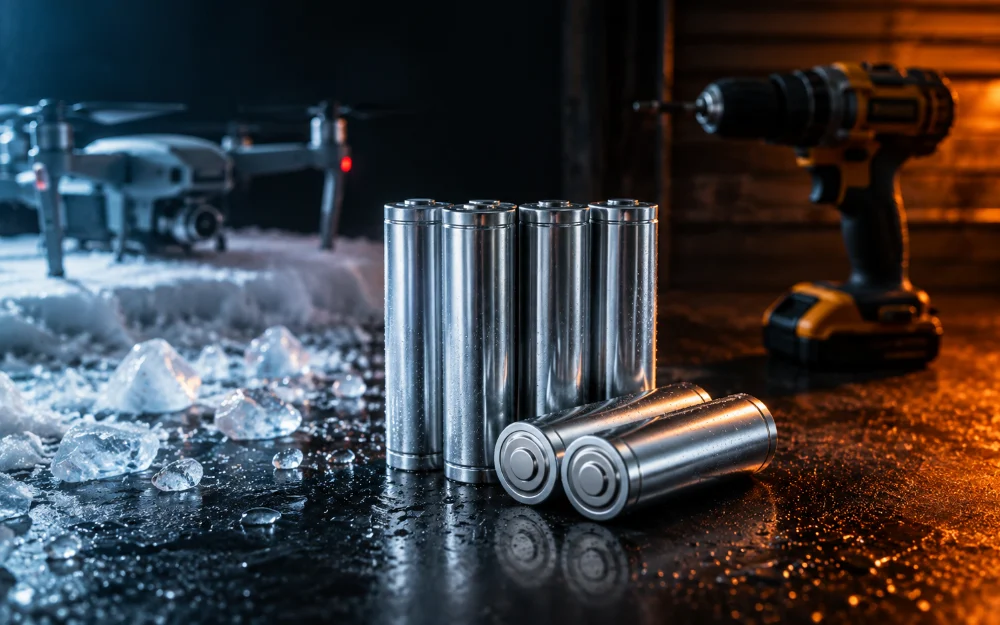
Battery Cell Selection & Integration for Custom Battery Packs
Cell Selection Starts with the Application
The right cell is determined by how the finished battery needs to perform. Lithogenix evaluates the application’s runtime, power demand, cycle expectations, operating temperature, and available pack space before comparing suitable cell options from its supply network. This application-first approach helps match cell characteristics to the actual battery pack architecture rather than selecting by capacity alone.
Before sampling begins, the responsible production location, assembly scope, inspection checkpoints, documentation requirements, and batch traceability plan are established. This gives every project a clear manufacturing structure suited to its actual technical and commercial requirements.
Match stored energy to the required operating time.
Capacity and energy density are evaluated against the device’s expected runtime, duty cycle, and available battery volume.
Account for both continuous and peak current demand.
Applications with motors, actuators, or other high-load components require cells that can support the necessary discharge performance without compromising the pack design.
Select for the expected service pattern.
Cell choice should reflect how frequently the battery will be charged and discharged and how long the finished system is expected to remain in service.
Plan for the environment the battery will actually face.
For applications exposed to high heat, extreme cold, or wide temperature swings, cell temperature capability becomes a primary selection factor.
Fit electrical performance into the available enclosure.
Cell format, dimensions, and configuration are considered together with the required voltage, capacity, and mechanical layout to support an efficient pack architecture.
- Global Cell Partner Network
Flexible cell sourcing for different battery architectures.
Lithogenix works with a broad network of trusted cell partners, giving our engineering team access to different chemistries, formats, capacities, discharge characteristics, and temperature capabilities. Instead of relying on a single cell platform, we can source and compare suitable options for each battery pack before integration.
Broad Sourcing Access
Our partner network gives us the flexibility to evaluate cells across multiple formats and performance profiles, helping us identify suitable options as battery designs and application requirements change.
Tier 1 & High-Reliability Cell Options
Lithogenix prioritizes Tier 1 brands and other high-reliability cell options when matching cells to an application, with a focus on consistent performance and stable long-term operation in the finished battery system.
Compare Before Integration
Suitable candidates can be compared across factors such as energy density, power output, cycle life, temperature performance, and physical format before the selected cell is integrated into the battery architecture.
- Chemistry Options
Chemistry Options for Different Battery Requirements
Battery chemistry affects how a finished battery performs in terms of energy density, discharge capability, service life, safety, and temperature tolerance. Lithogenix can evaluate different chemistry systems according to the priorities of each application and integrate the selected cell into the required battery architecture.
| Cell Chemistry | Typical Applications | Key Characteristics |
|---|---|---|
| NMC | IoT, Medical, Robotics, Mobile Technology | High energy density, high discharge rate |
| LFP | Marine, Electric Tools, Garden Tools | Long service life, enhanced safety |
| Sodium-ion | Outdoor Equipment, Drones, Low-Speed Electric Vehicles | Excellent low-temperature performance |
| Semi-solid | Industrial, Marine | High discharge rate, wide operating temperature range |
- Cell Formats
Cell Formats for Different Pack Architectures
Cell format influences how capacity, performance requirements, and available space come together in the finished battery pack. Lithogenix works with cylindrical, prismatic, and pouch cell formats across a wide capacity range to support different application and pack architecture requirements.
| Cell Format | Typical Capacity Range | Typical Applications |
|---|---|---|
| 14250 | 45mAh | IoT, Telematics |
| 14500 | 750–800mAh | IoT, E-Call, Telematics, AA Replacement |
| 18650 | 2600–4000mAh | Consumer Electronics, Mobile Devices, Medical Equipment |
| 26650 | 2500–4500mAh | Power Tools, Garden Tools, Remotely Operated Underwater Vehicles |
| 21700 | 4000–6000mAh | Robotics, Drones, Consumer Electronics, Medical Equipment |
| 32700 | 6000–7000mAh | Electric Mobility |
| 32800 | 8000mAh | Electric Mobility |
| Prismatic | 30–200Ah | Industrial, Marine |
| Pouch | 5–5000mAh | Wearables, Consumer Electronics |
- Cell Options for Extreme Operating Conditions
Flexible cell sourcing for different battery architectures.
| Operating Condition | Cell Capability | Typical Applications |
|---|---|---|
| High Temperature | Operating Range: -40°C to +85°C | Automotive, Outdoor Equipment, Industrial Monitoring |
| Low Temperature | Operating Range: -55°C to +60°C | Cold Chain Logistics, Extreme-Cold Environments |
| High Discharge | Continuous High-Discharge Capability | Drones, Power Tools |