
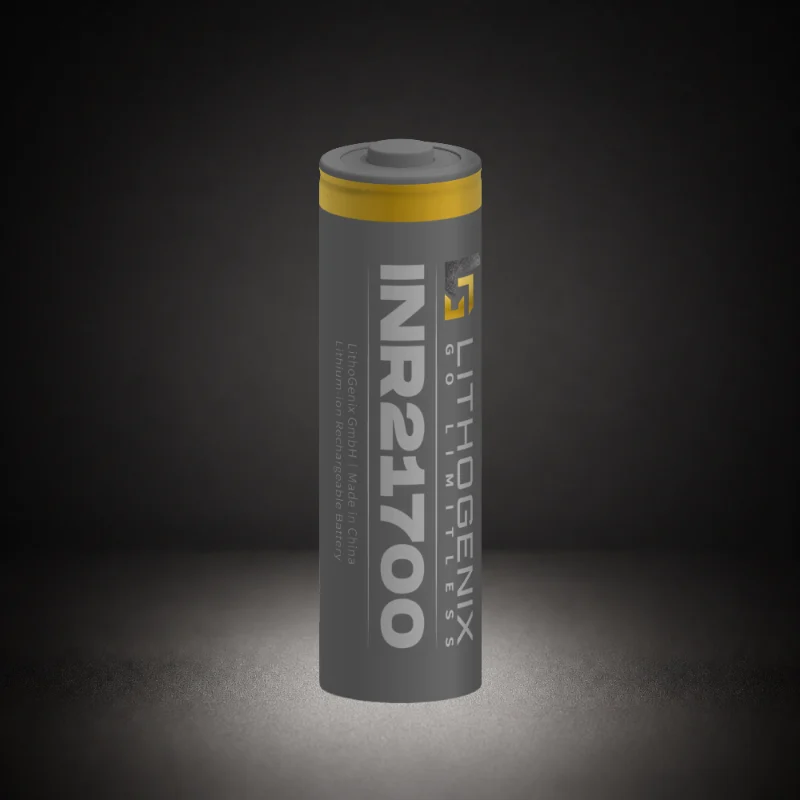
4000mAh Capacity with Strong Power Capability
The 21700-40E provides 4000mAh capacity in the larger 21700 cylindrical format, offering more stored energy per cell than lower-capacity high-power models while retaining substantial discharge capability.
This combination makes the cell suitable for battery systems that cannot optimize solely for either maximum runtime or maximum power. Instead, the 21700-40E provides a practical middle ground for equipment that needs meaningful energy capacity alongside demanding current output.
Up to 50A Maximum Discharge Current
According to supplier specifications, the 21700-40E supports a maximum discharge current of 50A, making it relevant to applications with high transient or operating power requirements.
Key electrical specifications include:
- Capacity: 4000mAh
- Nominal Voltage: 3.60V
- Working Voltage: 2.5–4.2V
- Maximum Charge Current: 6.0A
- Maximum Discharge Current: 50.0A
- Energy Density: Approx. 205Wh/kg
- Standard Cycle: 300 cycles at 25°C
- Maximum Weight: 70g
- Dimensions: Approx. 21.15 × 70.15mm
Actual allowable current at pack level should be determined according to cell temperature, duty cycle, BMS limits, interconnection design, and thermal conditions.
More Stored Energy per Cell for Compact Pack Design
The 4000mAh capacity allows designers to achieve higher pack energy with fewer cells than lower-capacity alternatives, depending on voltage and runtime requirements.
Using fewer cells can potentially reduce:
- Cell-to-cell interconnections
- Welding points
- Pack assembly complexity
- Space required for parallel cell groups
- Supporting structural components
These advantages can be particularly useful in mobility and portable-power products where battery volume, weight, and mechanical packaging must be carefully balanced.
A Balance Between Runtime and High-Current Performance
Compared with the 21700-30P, which is positioned more heavily toward high-power output, the 21700-40E adds greater capacity for applications that also need extended operating time.
This makes the 40E better suited to systems where the battery must handle substantial loads but still deliver meaningful runtime between charging cycles.
For applications where maximum energy storage is the dominant requirement and current demand is relatively moderate, a higher-capacity 21700 model may provide a better fit.
Typical Applications
The capacity and current characteristics of the 21700-40E make it suitable for applications such as:
- E-bike battery packs
- Electric scooter battery packs
- Portable power systems
- High-capacity power banks
- Outdoor and camping power equipment
- Commercial cleaning robots
- Service robots
- AI companion robots
- Other rechargeable equipment requiring both energy capacity and strong power output
Application suitability should ultimately be evaluated according to voltage, current profile, operating temperature, cycle-life target, and mechanical constraints of the finished battery system.
Custom 21700 Battery Pack Integration
Lithogenix can integrate the 21700-40E into customized lithium-ion battery packs according to required voltage, capacity, discharge current, runtime, dimensions, connector type, and protection strategy.
Pack development can include series-parallel configuration, BMS selection, cell interconnection design, wiring, enclosure integration, thermal management, and pack-level validation.
For higher-current systems, special attention can be given to busbar and conductor design, connection resistance, temperature rise, and protection settings to ensure that the finished pack configuration is properly matched to the equipment’s operating profile.