
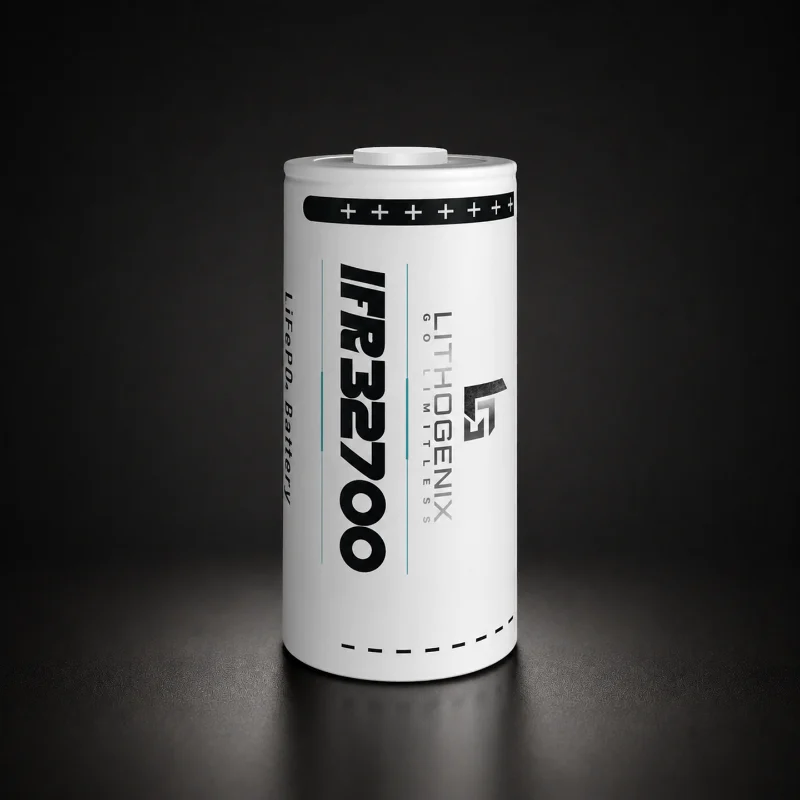
The IFR32700 LiFePO₄ Cylindrical Cell is intended for rechargeable battery systems that operate repeatedly over long service periods and place a high value on durability, stable power delivery, and manageable thermal performance.
Rather than being optimized for the highest possible energy density, this cell format is better suited to applications where the battery may charge and discharge regularly for years. This makes it particularly relevant to stationary storage, industrial mobility, backup power, and other systems where battery replacement frequency directly affects operating cost.
Efficient Power Delivery with Lower Thermal Stress
IFR32700 is designed to deliver electrical power efficiently while limiting unnecessary heat generation during normal operation.
This characteristic is especially valuable in multi-cell battery packs, where internal resistance and heat accumulation can influence:
- pack efficiency
- temperature uniformity
- thermal-management requirements
- usable power
- long-term cell consistency
A more thermally manageable cell platform can simplify system design, although pack-level cooling, spacing, current distribution, and protection still need to be engineered around the actual application.
Designed for Long-Term Cycling
One of the main reasons to select LiFePO₄ chemistry is its suitability for applications that experience repeated charge and discharge cycles.
IFR32700 is positioned for equipment where battery lifetime is evaluated across years of operation rather than only by runtime from a single charge.
This makes it particularly relevant when reducing battery replacement frequency can lower:
- maintenance requirements
- system downtime
- replacement cost
- lifecycle operating expense
For commercial and industrial users, this long-service perspective can improve the overall return on the battery system investment.
Energy Storage Systems
IFR32700 can be integrated into rechargeable battery modules for stationary energy storage systems where cycle durability and predictable long-term operation are key design priorities.
Typical uses may include:
- distributed energy storage
- renewable-energy storage
- commercial backup batteries
- small and medium stationary battery systems
- industrial energy buffering
Pack voltage and energy can be scaled through series and parallel cell configurations according to the required system architecture.
AGVs & Electric Forklifts
Automated guided vehicles and electric material-handling equipment may undergo frequent charging and discharging throughout daily operation.
For these applications, the battery must support not only traction demand but also repeated operational cycles over a long service period.
IFR32700 is suitable for rechargeable packs used in selected:
- AGVs
- warehouse transport equipment
- electric forklifts
- autonomous material-handling vehicles
- industrial mobile platforms
The final pack should be designed around motor current, operating shift length, charging opportunity, thermal conditions, and required cycle life.
Telecom Base Station Backup
Telecommunication infrastructure requires backup batteries that can remain available for long periods and provide power when the primary supply becomes unavailable.
LiFePO₄ battery packs based on IFR32700 can be considered for telecom base stations, communication cabinets, network infrastructure, and remote communication equipment.
For these systems, battery design should account for standby behavior, outage duration, charging strategy, operating temperature, and required backup runtime.
UPS & Critical Backup Power
IFR32700 is also suitable for rechargeable battery packs used in UPS and critical-power applications.
Its long-life characteristics make it relevant to systems where the battery may remain in standby for extended periods but must support protected equipment during mains interruptions.
Typical applications can include:
- industrial UPS
- communication backup
- control-system backup
- network equipment
- critical electronics
- distributed DC backup systems
Battery capacity and pack configuration should be matched to the required system voltage, protected load, and target runtime.
Marine & RV Power Systems
Marine and recreational vehicle systems often combine repeated cycling with extended periods away from fixed power infrastructure.
IFR32700 can be used in battery packs for onboard auxiliary power, lighting, electronics, appliances, communication equipment, and other DC loads.
For these applications, pack design should also consider vibration, installation space, charging source, environmental temperature, moisture protection, and electrical isolation.
Where IFR32700 Fits Best
IFR32700 is particularly suitable when a battery system prioritizes:
- long operational life
- repeated cycling
- efficient power delivery
- manageable heat generation
- reduced replacement frequency
- scalable pack construction
- predictable lifecycle cost
It is therefore a stronger fit for long-term industrial and energy applications than for products whose primary objective is maximum energy density from the smallest possible battery volume.