
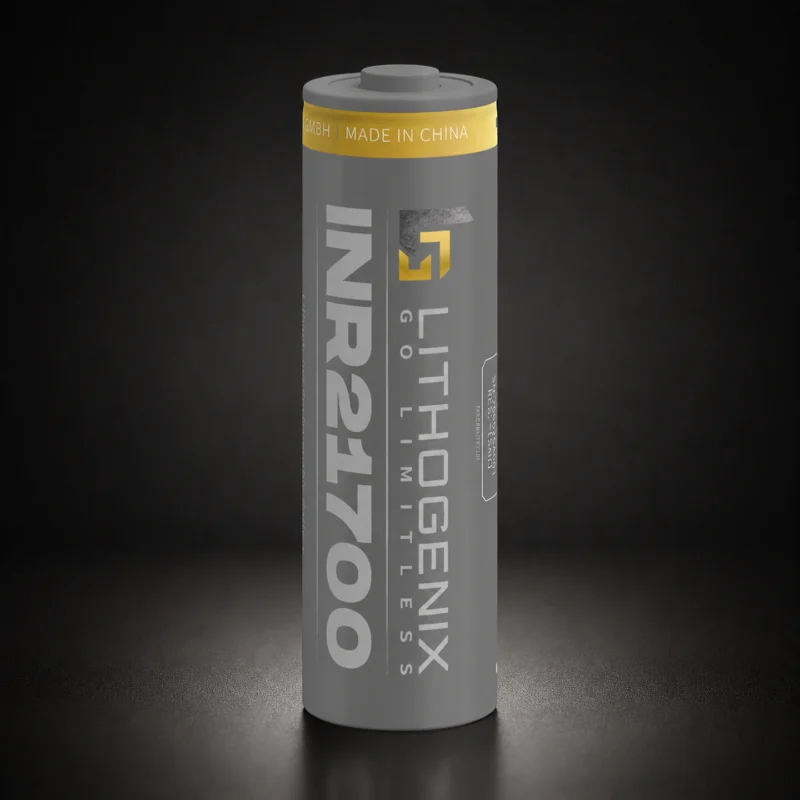
The INR21700M50 Lithium-ion Cylindrical Cell is designed for applications where available energy and operating time matter more than maximum discharge current.
With 5000 mAh nominal capacity and approximately 18 Wh of energy per cell, this 21700-format cell allows battery-pack designers to reach a given energy target with fewer cells than lower-capacity cylindrical formats.
That can simplify pack architecture while reducing the number of cell connections, weld points, and parallel groups required for the same total energy.
Higher Energy Per Cell for Longer Runtime
The main advantage of INR21700M50 is its large energy reserve within a single cylindrical cell.
At approximately 18 Wh per cell, fewer individual cells may be required to achieve the desired pack capacity compared with lower-energy 18650 designs.
This can be especially valuable in systems where:
- operating time is a primary design target
- battery compartment volume is limited
- reducing cell count is desirable
- pack complexity needs to be controlled
- energy density matters more than extreme current capability
For mobility, robotics, and industrial battery packs, this higher energy per cell can translate into longer usable runtime or a simpler pack configuration.
14.7 A Continuous Discharge for Moderate-Power Systems
INR21700M50 supports up to 14.7 A continuous discharge, giving it sufficient current capability for many mobility, robotic, backup-power, and industrial applications.
Its power profile is better suited to systems with moderate and sustained electrical demand than to products requiring extremely high current from each individual cell.
Typical loads may include:
- traction motors under controlled current demand
- robotic drive systems
- pumps and actuators
- communication electronics
- industrial controllers
- backup-power loads
- portable power equipment
Where a system requires substantially higher current, pack-level parallel configuration or a dedicated high-power cell should be considered.
Fewer Cells for a Given Pack Energy
High-capacity cells can provide an important pack-level advantage beyond runtime alone.
If fewer cells are required to reach the target energy, the battery pack may also require fewer:
- electrical interconnections
- welded joints
- parallel cell groups
- cell holders
- monitoring points
This can simplify mechanical layout and electrical architecture, although final pack design must still account for current sharing, thermal management, redundancy, serviceability, and safety requirements.
Typical Applications
E-Bikes & E-Scooters
Suitable for electric bicycles, scooters, and other compact mobility systems where range and usable energy are more important than extreme per-cell current.
Service Robots & AGVs
Well suited to mobile robots and automated guided vehicles that operate for extended periods between charging cycles and require a balance of energy capacity and moderate power output.
UPS & Backup Power
Can be integrated into rechargeable backup battery packs for communication systems, industrial electronics, and other equipment requiring stored energy during interruptions of the primary power source.
Portable Power Systems
Applicable to portable power equipment and mobile energy systems where high energy capacity per cell helps reduce overall cell count.
Medical & Communication Equipment
Can be considered for selected rechargeable equipment where long runtime, compact pack architecture, and moderate continuous power demand are important.
Long-Runtime Industrial Battery Packs
Suitable for industrial electronics, mobile equipment, monitoring systems, and other applications designed around extended operating periods rather than short high-power bursts.
Built for Energy Density Rather Than Extreme Power
INR21700M50 should not be treated as a direct replacement for high-power 18650 cells such as those designed for 30 A or higher continuous output.
Its strength is different.
This cell is better matched to systems that prioritize:
- higher usable energy
- longer runtime
- fewer cells per pack
- moderate continuous discharge
- balanced cycle performance
If the application requires 30–60 A continuous current from each individual cell, a dedicated high-rate cell is the more appropriate choice.
Cycle-Life Performance
Supplier test data indicates more than 85% capacity retention after 1000 cycles under a 0.5C charge / 1C discharge test profile.
This makes INR21700M50 relevant to rechargeable systems expected to undergo repeated cycling over an extended operating period.
Actual cycle life in the finished battery pack will depend on factors such as:
- charge and discharge rates
- depth of discharge
- operating temperature
- thermal management
- upper and lower voltage limits
- cell balancing
- pack design
- usage pattern
The supplier test result should therefore be treated as a reference condition rather than a guaranteed lifetime for every application.